Summary
Thai Airways has quietly reverted to a flat-rate pricing system for its airport standby upgrades, making business class access on Asia routes predictable and surprisingly affordable. The official chart sets Bangkok–Denpasar at 7,100 THB (approximately $182), and the upgrade is sold at the check-in counter on departure day with no bidding process.
The program excludes award tickets and the lowest economy booking class, and miles accrue only on the original fare — not the upgraded cabin. With availability checked on ExpertFlyer, a traveler recently secured the last seat for a four-hour flight at a total outlay of 387 EUR.
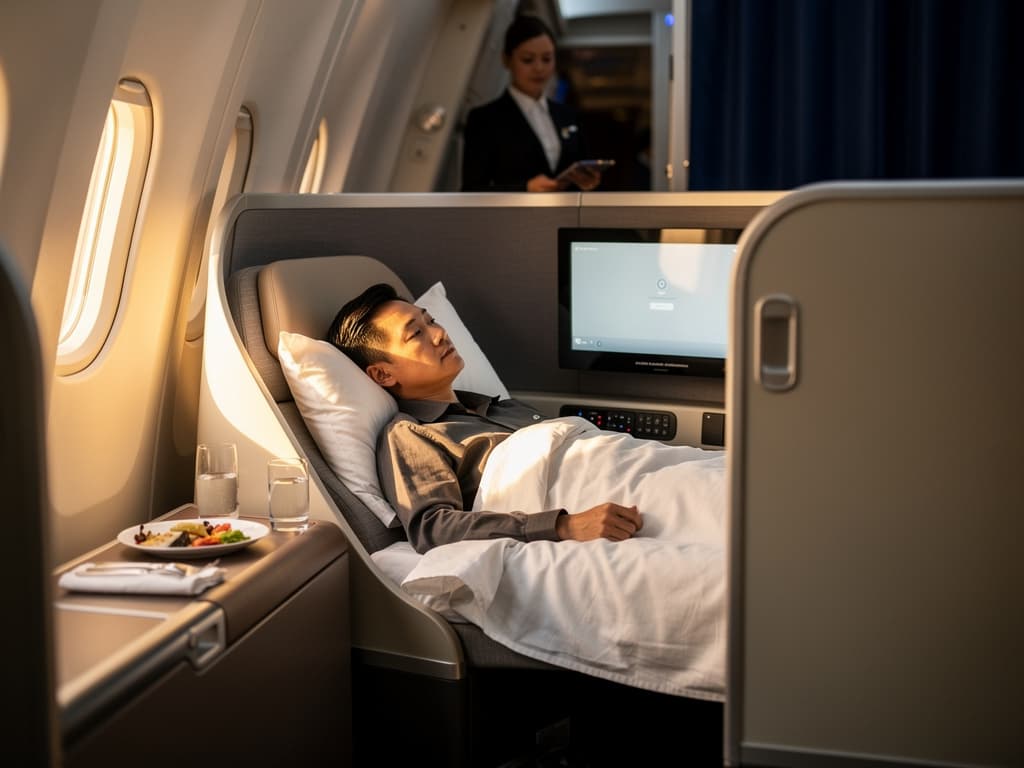
For years, Thai Airways has dangled a quiet workaround for travelers who want business class comfort without springing for a confirmed premium fare. The airline’s standby upgrade — sold only at the airport on the day of travel — has now jettisoned its old tiered pricing tied to booking class, simplifying the proposition into a clear route-group chart. On a recent Bangkok–Denpasar run, the upgrade cost 7,100 THB, turning a 205-euro economy ticket into a 387-euro business class seat with lounge access, priority boarding, and a full inflight meal service.
The new flat-rate structure removes the guessing game. Under the previous system, a high-fare Y or B class ticket unlocked upgrades as low as $40 on short Asian hops; travelers in deeply discounted buckets paid more. Now, any eligible revenue fare — except bottom-rung “L” class and industry/ZED discounts — pays the same rate regardless of booking class. That means someone holding a promotional W fare, like the Bangkok–Denpasar passenger, pays the identical upgrade fee as a full-fare traveler on the same route.
For itineraries originating in Bangkok, the chart clusters routes into clear bands. Southeast Asian sectors including Singapore, Jakarta, Manila, and Denpasar all sit at 7,100 THB. Farther-flung Northeast Asian destinations — Seoul, Tokyo, Osaka — require 18,000 THB. Long-haul European hubs such as Frankfurt jump to 40,000 THB (about $1,100), making the product distinctly less attractive for cross-continental journeys.
The only way to buy the upgrade is in person at the Thai Airways ticketing counter on departure day. Seats are sold on a space-available basis, and payment is taken right at check-in. The airline’s official terms confirm no advance reservation, no bidding window, and no app-based interface — a throwback model that rewards early airport arrival and real-time seat hunting.
The new standby upgrade chart and how it works
Thai Airways publishes the full pricing table on its website, including a “Revision 31 JAN 25” note that signals the flat-rate system is now the current standard. The Bangkok–Denpasar rate of 7,100 THB sits in a tier that also covers routes to Singapore, Jakarta, Manila, Kuala Lumpur, and several Chinese cities. Payment options at the airport include credit cards, though not all terminals accept American Express, so a Visa or Mastercard is safer.
The eligibility rules are refreshingly simple. Passengers holding confirmed economy tickets — except booking class “L” and tickets issued as industry discounts, travel agent fares, ZED tickets, or Royal Orchid Plus award redemptions — qualify, provided space exists. There is no minimum check‑in time stated by the airline, but completing the upgrade at least two hours before departure unlocks the full business class benefits: priority baggage allowance, lounge access, and the onboard meal service.
Importantly, the product is not a ticket reissue. The standby upgrade is handled as a surcharge, meaning the underlying fare basis remains unchanged. That arrangement keeps the process fast — the entire transaction took five minutes in the Denpasar case — but has a direct loyalty consequence: miles post based on the original economy fare class, not the business cabin flown. For mileage collectors, that is the key trade-off against competitors’ bidding-based upgrades.
| Route group | Upgrade fee (THB) | Approximate USD equivalent |
|---|---|---|
| Singapore, Jakarta, Denpasar, Manila, Kuala Lumpur, Ho Chi Minh City, and select China cities | 7,100 | $182 |
| Seoul, Busan, Tokyo, Osaka, Nagoya, Fukuoka, Sapporo | 18,000 | $463 |
| Frankfurt | 40,000 | $1,030 |

Flight deals most people never see
Our AI monitors 150+ airlines for pricing anomalies that traditional search engines miss. Air Traveler Club members save $650 per trip per person on average: see how it works.
Each deal saves 40–80% vs. regular fares:

Why the flat-rate reset matters now
Ditching the old booking‑class‑sensitive pricing streamlines the program but removes the hidden perk for travelers on full‑fare tickets. The old model sometimes let corporate flyers upgrade for as little as $40 on short hops like Bangkok–Singapore. The current flat rates are higher for those deep-fare buckets, yet they remain a fraction of a confirmed business class fare. On the Bangkok–Denpasar corridor, the total all‑in cost of 387 EUR undercuts a Singapore Airlines KrisFlyer award priced at 26,000 miles plus 161 EUR in taxes — a scenario where burning points buys very little incremental value.
That cash-vs‑points arithmetic is precisely why the standby upgrade appeals to value‑focused premium travelers who want a better seat without depleting mileage balances. Air Traveler Club’s recent analysis of Bangkok’s fast track removal for premium passengers underscores how ground experience matters: while the upgrade includes lounge access, arrivals in Bangkok no longer shortcut immigration, a nuance worth factoring into the overall premium journey.
How to use Thai Airways’ standby upgrade for your next Asia flight
The flat-rate structure gives travelers a predictable premium option on short- and medium-haul Asia routes, provided they can work within the airport‑counter constraints.
- Check the official chart before booking. Confirm your route’s upgrade fee on Thai Airways’ website, because the bands are fixed and route‑specific. A Bangkok–Denpasar ticket at 7,100 THB stays that price regardless of fare class.
- Arrive at the airport early, not just on time. Seat availability is first‑come, first‑served. Using ExpertFlyer to eyeball open business class seats the night before gives you a realistic picture, but nothing beats being at the counter when check‑in opens.
- Exclude L‑class and award tickets entirely. These fare types are expressly blocked. If you hold an award or industry‑discount ticket, do not expect to buy the upgrade — the airline’s terms are firm.
- Bring a credit card, preferably not Amex. While some terminals may accept American Express, the safer play is a Visa or Mastercard. The agent processes payment directly at the check‑in counter.
- Accept that miles remain at economy earning rates. Because the upgrade is a surcharge rather than a ticket reissue, no business‑class redeemable miles or status credits post. Factor that into your loyalty calculus.
Watch for any revision to the official chart or an expansion to online check‑in — either would signal Thai Airways is treating standby upgrades as a mature ancillary product rather than a niche airport exception.
FAQ
What is the exact cost to upgrade economy to business on Bangkok–Denpasar?
The official flat‑rate standby upgrade fee is 7,100 THB, approximately 182 EUR or $182, regardless of which economy fare class you hold (except ineligible “L” class). This is a departure‑day, airport‑only purchase, subject to seat availability.
Can I use this upgrade on an award ticket?
No. The program explicitly excludes Royal Orchid Plus award redemptions, industry discount tickets, travel agent fares, and ZED tickets. Only revenue fare tickets — except booking class “L” — are eligible.
Does the standby upgrade include lounge access?
Yes, provided the upgrade is processed at least two hours before departure. You also receive the business class checked baggage allowance and the onboard meal service. If processed closer to departure, lounge access and meals may not be guaranteed.
Read more