Summary
German investigators found the nose-gear locking pin still in its storage box — not installed — when a Lufthansa Boeing 787 collapsed during maintenance at Frankfurt, making the June 4, 2026, incident far more alarming: a simple procedural skip, not a misinstallation.
The aircraft, a nearly new 787-9, remains grounded with no return timeline, and the discovery sets this apart from a similar 2021 British Airways collapse, signaling possible systemic maintenance oversight that may prompt regulatory action.
The German Federal Bureau of Aircraft Accident Investigation (BFU) delivered its most startling finding yet on July 10, 2026: the locking pin designed to physically prevent the nose landing gear from retracting was found in its storage box, its red warning flag brightly visible, while the main landing-gear pins were correctly installed.
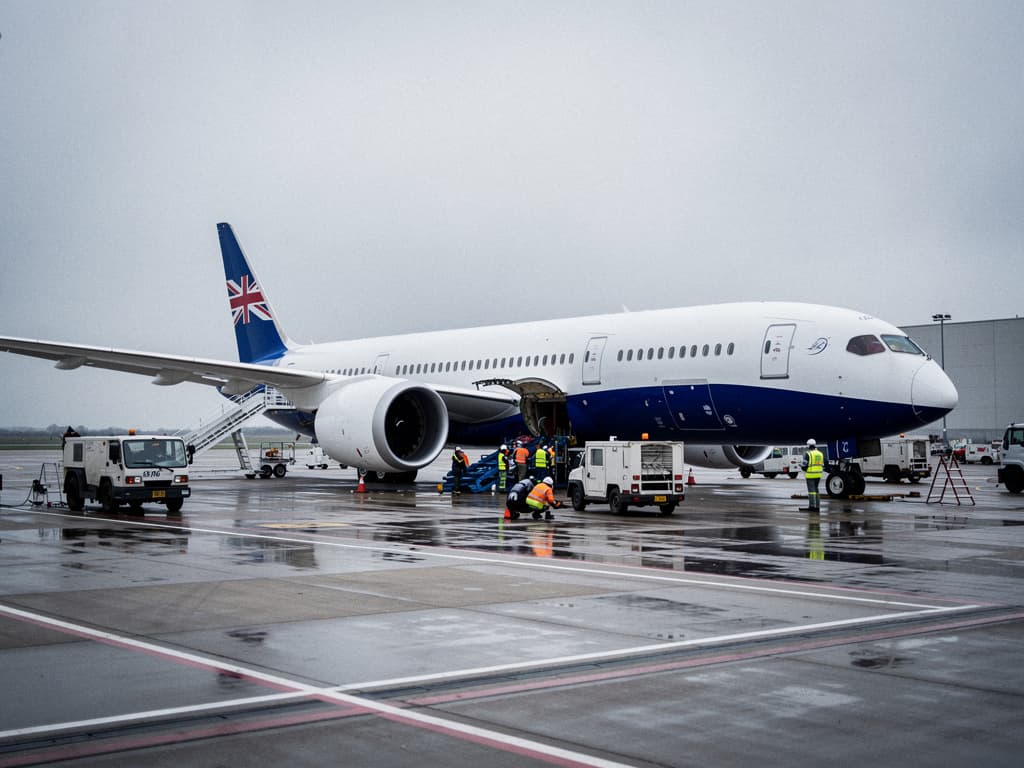
The omission explains how Lufthansa flight LH450‘s brand-new Boeing 787-9 (registration D-ABPQ) collapsed onto the apron at Frankfurt Airport Gate A15 at approximately 12:45 local time on June 4.
Twenty-eight people — technicians, flight crew, cabin crew, and ground staff — were on board or working directly around the jet. No passengers had boarded. Two cabin crew and two service-provider employees required hospital treatment, though all were discharged the same day.
The aircraft had been in service barely four months, delivered by Boeing in January 2026 and entering revenue flights in February. The damage is substantial, and Lufthansa has not announced when D-ABPQ will return to its schedule.
Technicians had been troubleshooting a fault in the main landing-gear door control system, a procedure that required cycling the landing-gear lever to the up position. Locking pins should have blocked the gear from retracting during that test. The BFU’s interim report stops short of explaining why the nose pin was never inserted, leaving open questions about checklist adherence and ground-crew supervision.
The details
The BFU’s interim report, released July 10, 2026, confirms that the nose-gear pin was discovered in its allocated storage box after the collapse. Pins for both main gear assemblies had been fitted, meaning the gear-up command retracted the unprotected nose gear, and the front of the aircraft pitched forward onto the tarmac, video of which circulated widely.
The investigation is now examining maintenance records, hydraulic and sensor data, and ground-crew procedures. Boeing is cooperating, providing onboard monitoring data that may clarify exactly what happened in the seconds before collapse. Detailed analysis of the BFU findings reveals that investigators are not treating this as a duplicate of the 2021 British Airways 787-8 nose-gear collapse at London Heathrow. In that case, the locking pin was installed but inserted into the wrong hole, a mistake that UK authorities said could give misleading tactile feedback. Here, the pin was simply never used.
That distinction is significant. It turns the focus away from physical misdesign and toward the possibility of a gap in procedural discipline — a type of error that can exist across any airline’s maintenance operation if checklists are not rigorously enforced.
No safety recommendations have been issued yet, but the BFU final report, expected in about one year, will likely address whether existing 787 locking-pin protocols are sufficient.
| Date | Event | Impact | Status |
|---|---|---|---|
| February 2026 | Aircraft D-ABPQ enters commercial service | Lufthansa’s newest 787-9 joins FRA–LAX fleet | Operational |
| June 4, 2026 | Nose gear retracts during maintenance at FRA Gate A15 | 28 people on board/exposed; 4 hospitalized; flight LH450 cancelled | Incident; aircraft grounded |
| July 10, 2026 | BFU releases interim report confirming locking pin omission | Pin found in storage box; procedural questions raised | Investigation ongoing; final report expected mid-2027 |

Flight deals most people never see
Our AI monitors 150+ airlines for pricing anomalies that traditional search engines miss. Air Traveler Club members save $650 per trip per person on average: see how it works.
Each deal saves 40–80% vs. regular fares:

Why a missing pin changes the investigation
The BFU’s finding reshapes the inquiry. The 2021 BA event triggered recommendations around physical design, but an entirely omitted pin points to human performance — checklist compliance, shift handovers, and supervision — that no hardware fix can eliminate.
Air Traveler Club’s coverage of a recent British Airways 787 grounding, where engineering steps impaled the fuselage during routine maintenance, shows how even straightforward procedures can endanger multi-million-dollar aircraft when procedural rigor slips. Together, these events suggest that while the 787 is a mature platform, maintenance discipline remains its weakest link.
What the omitted pin means for 787 operations
The BFU’s conclusion that the pin was never taken out of storage shifts scrutiny from hardware design to human procedural discipline — a vulnerability that affects every airline operating the 787.
Travelers on the FRA–LAX corridor should watch for Lufthansa schedule adjustments within the next 30 days; a capacity reduction would likely tighten premium seat availability in both cash and award inventory. Meanwhile, the BFU’s final report, expected mid-2027, may trigger European Union Aviation Safety Agency (EASA) airworthiness directives for all 787 operators if systemic procedural gaps are identified.
FAQ
Will Lufthansa’s FRA–LAX flights be disrupted?
No immediate disruptions are expected, but the prolonged grounding of D-ABPQ — one of Lufthansa’s newest 787-9s — may tighten seat availability on this high-demand premium corridor if the airline cannot substitute similar capacity. Monitor Lufthansa flight schedules and award inventory.
What caused the nose gear to collapse?
The BFU interim report confirms that the nose-gear locking pin was not installed; technicians moved the landing-gear lever to the up position for troubleshooting, and the unprotected nose gear retracted, causing the front of the aircraft to drop onto the apron. The main-gear pins were correctly installed.
Is this related to the 2021 British Airways 787 collapse?
Both incidents involve nose-gear retraction during maintenance with locking-pin errors, but the failures differ: the BA event involved a pin inserted into the wrong hole, while the Lufthansa pin was completely omitted. The BFU has not yet commented on any common procedural factors.
Read more