Summary
All Nippon Airways has engineered a full-door business class suite onto the Boeing 787-9 Dreamliner — a fuselage that has historically resisted such ambitions. The carrier’s new The Room FX product packs 48 enclosed suites into a 1-2-1 alternating layout, achieving a sleeping surface of 76.5 inches long and 41.5 inches wide at its broadest point, by abandoning the traditional recline mechanism entirely in favor of a sofa-style fixed seat. Designed with Safran Seats and Acumen, the first aircraft enter service in August 2026.
The rollout covers new deliveries only — existing 787-9s will not be retrofitted. Award inventory on equipped aircraft is expected to be tight from launch.
The business class suite door has long been the privilege of wide-body flagships. All Nippon Airways has just changed that calculus, fitting a fully enclosed, door-equipped suite onto the Boeing 787-9 — a narrower aircraft that seat designers have historically treated as a constraint rather than a canvas.
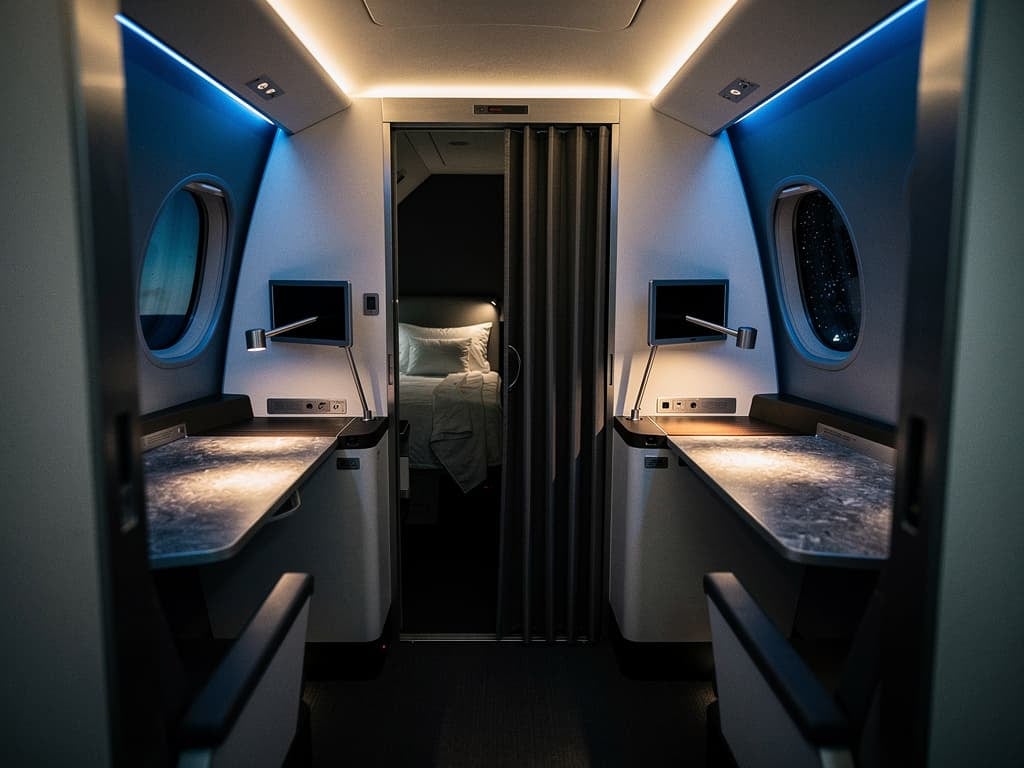
The engineering solution is elegant in its simplicity: eliminate the recline mechanism. By fixing the seat in a pre-reclined sofa position and using a sliding leg rest to create a flat bed, ANA and its design partners at Safran Seats freed up enough structural real estate to install 48 suites in a 1-2-1 alternating forward/rear-facing configuration — with privacy doors on every single one. That figure compares to 30 suites on prior ANA 787-9 configurations, and exceeds what most competitors manage on the same aircraft type.
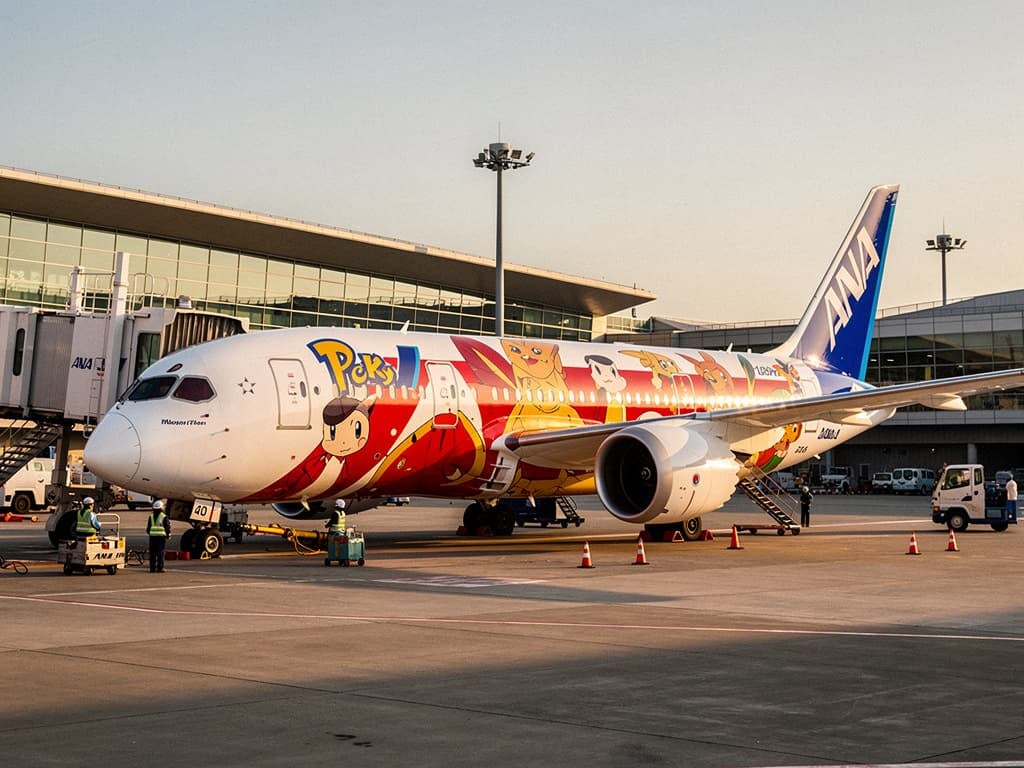
The first The Room FX-equipped aircraft are scheduled to enter service in August 2026, initially on major long-haul routes from Tokyo. The product applies exclusively to new deliveries; ANA’s existing fleet of 44 787-9s will not receive the upgrade.
For those targeting ANA’s premium cabin on Pacific and Europe routes, this represents a meaningful shift in what the 787-9 can deliver — and a booking intelligence challenge, since only a subset of flights will carry the new configuration at launch.
The engineering behind the suite
The 787-9’s fuselage imposes hard limits. Its narrower cross-section and inward-tapering sidewalls leave less usable floor space than the 777-300ER, and traditional business class seats — with their bulky actuators, pivot mechanisms, and longitudinal recline travel — consume that space quickly. Fitting a 1-2-1 layout with direct aisle access and enclosed doors into that environment, using conventional seat architecture, is effectively impossible at 48-seat density.
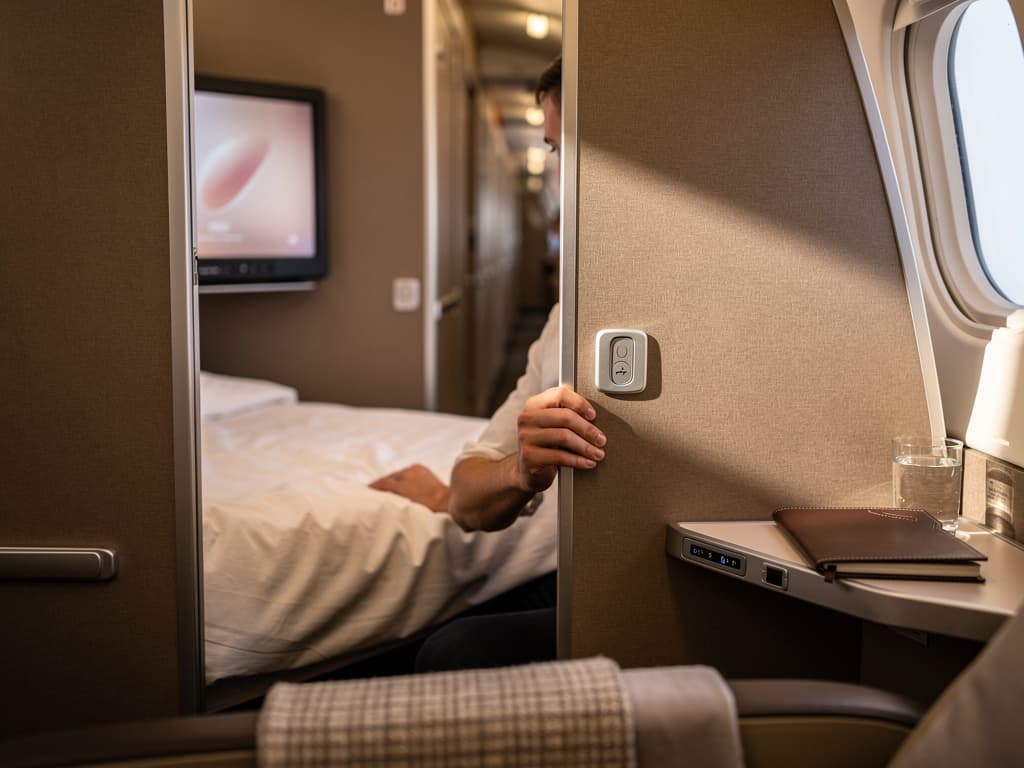
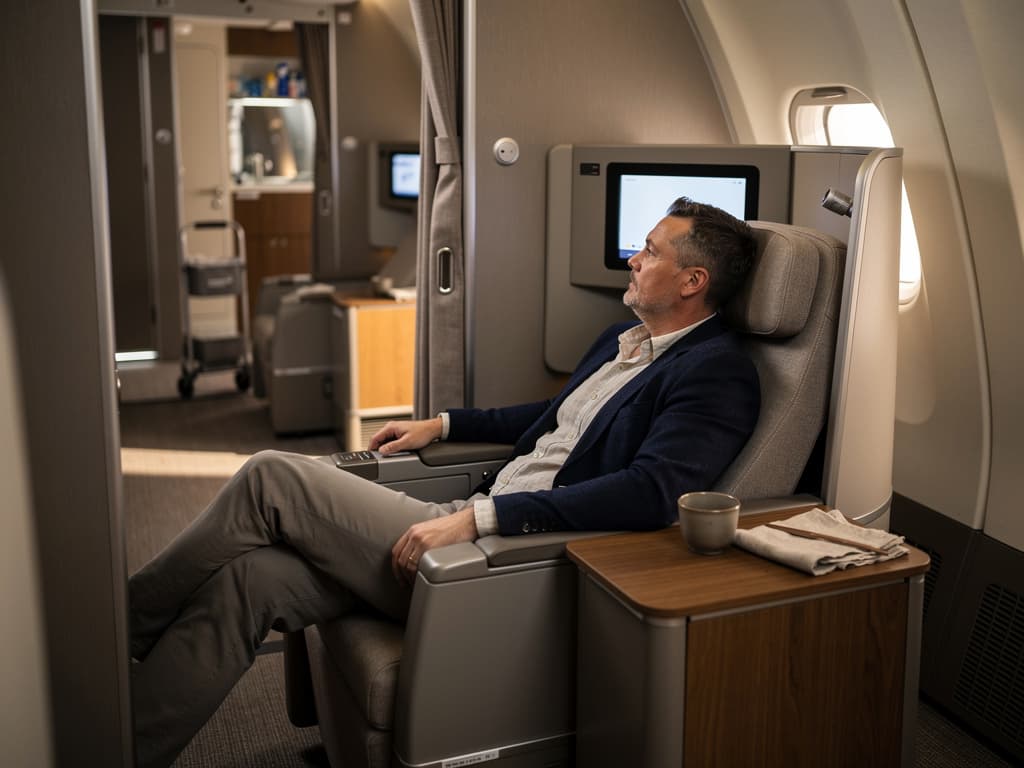
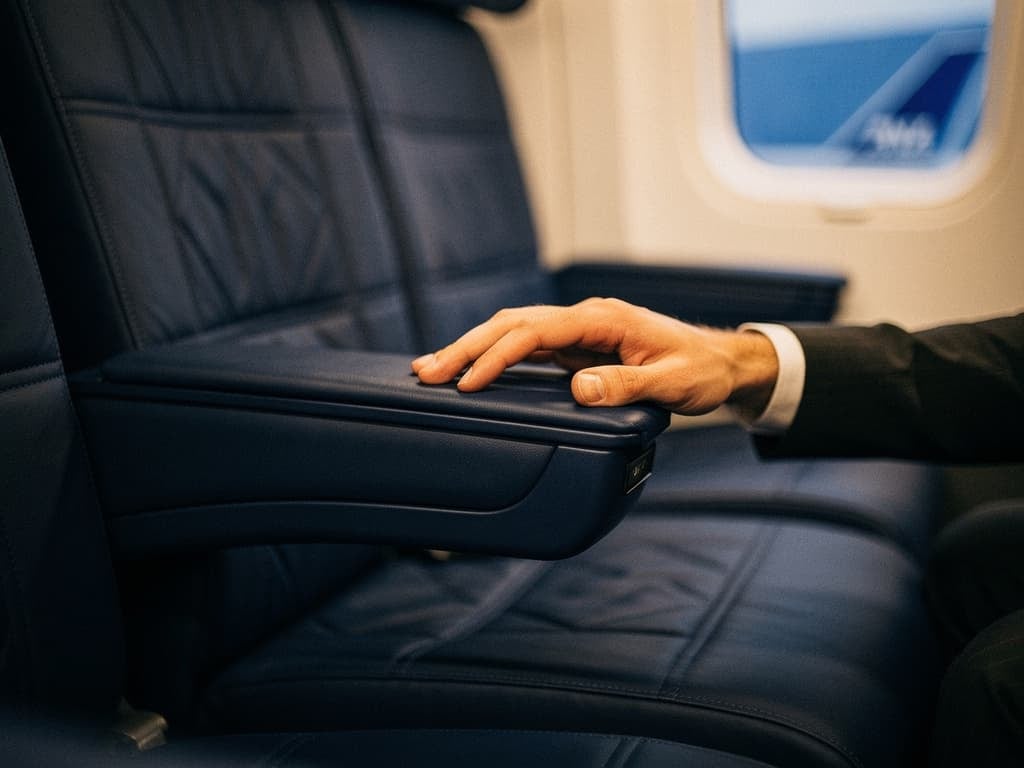
ANA’s answer was to remove the recline mechanism altogether. The sofa-style seat sits fixed in a pre-reclined position; passengers slide forward and extend a leg rest to create the flat sleeping surface. This eliminates the under-seat mechanical assembly, freeing volume that designers redirected toward width and suite wall architecture. The result: a bed measuring 76.5 inches in length and 41.5 inches at its widest point, narrowing to approximately 27 inches at the waist — dimensions that would be structurally unachievable with a conventional recliner in the same cabin footprint.
The suite walls themselves contribute as much as the seat mechanism. Rather than flat vertical panels, The Room FX uses subtly curved backrest walls and sculpted surfaces that follow the fuselage contour. These curves allow each suite to sit closer to the sidewall without encroaching on passenger space, effectively reclaiming inches that the cabin’s inward taper would otherwise render unusable. Safran achieved this curvature using advanced materials and optimized structural designs that maintain rigidity without adding weight — a critical constraint in aircraft interiors where every kilogram affects operating economics.
The alternating forward/rear-facing layout completes the density equation. By staggering footwells in opposite directions, adjacent seats interlock — reducing the pitch required per row and allowing 48 suites to occupy a cabin that previously held 30 to 36.
| Airline / Product | Suite count (787-9) | Privacy door | Bed length | Layout |
|---|---|---|---|---|
| All Nippon Airways — The Room FX | 48 | Yes — sliding door | 76.5 inches | 1-2-1 alternating fwd/rear |
| United Airlines — Polaris | ~44 | Yes — door on select configs | ~78 inches | 1-2-1 |
| Etihad Airways — Business | 30–36 | No (standard config) | ~78 inches | 1-2-1 |
| Qatar Airways — Qsuite | ~30 (on 787 routes) | Yes | ~78 inches | 1-2-1 (quad convertible) |

Flight deals most people never see
Our AI monitors 150+ airlines for pricing anomalies that traditional search engines miss. Air Traveler Club members save $650 per trip per person on average: see how it works.
Each deal saves 40–80% vs. regular fares:

Where this sits in the premium cabin landscape
ANA’s original The Room on the Boeing 777-300ER, introduced around 2019, reset expectations for business class width and residential feel — prompting competitors including Japan Airlines and United Airlines to accelerate their own cabin upgrades. The Room FX follows a similar strategic logic to what Qatar Airways executed when it fitted Qsuite onto the 777 in 2017 despite that aircraft’s own spatial constraints: use engineering ingenuity to bring flagship-level privacy to a platform where rivals haven’t managed it.
The density advantage is the headline differentiator. At 48 suites, ANA achieves the highest confirmed count of full-door business class suites on any 787-9 operator — a figure that matters both commercially and for award availability. More seats means more inventory, which historically correlates with better partner award release on Star Alliance routes.
Air Traveler Club’s analysis of how the 787 program reshaped airline network planning provides useful context here: the 787’s point-to-point efficiency made it the preferred instrument for long-haul expansion, which is precisely why premium cabin parity with larger widebodies matters so much on this type. ANA is effectively closing the gap between mid-size and flagship widebody premium products — and doing so on the aircraft that now anchors Pacific and Europe long-haul for much of the industry.
The August 2026 service entry also puts pressure on United Airlines and Etihad Airways, both major 787-9 operators, to respond. United’s Polaris product on the type offers doors on select configurations but trails on suite density; Etihad’s standard business cabin lacks doors entirely.
How to target The Room FX before the crowd catches on
The August 2026 service entry creates a narrow window where informed travelers can secure The Room FX before it becomes widely known — but only on the right aircraft. New deliveries only carry the product; ANA’s existing 44 787-9s will not be retrofitted, making aircraft identification the first booking task.
- Identify equipped flights via seatmap: Search ANA.com for 787-9 itineraries from Tokyo Narita showing 48 business class seats or labeled “The Room FX.” Flights showing 30–36 business seats are older configurations without doors.
- Target NRT-Europe and NRT-US West routes from August 2026: These are the confirmed long-haul corridors for initial deployment. Specific flight numbers have not been officially confirmed, so monitor ANA’s schedule releases through Q2 2026.
- Book Star Alliance partner awards early: United Airlines MileagePlus members can search ANA award space in *Z or *P fare classes. Inventory on new-configuration aircraft will be limited at launch — expect premium demand to compress availability within 60 days of schedule opening.
- Use ExpertFlyer for J-class inventory monitoring: Set alerts for ANA business class on 787-9 routes post-August 2026 to catch award release windows before they fill.
- Watch Q2 2026 delivery confirmation: If ANA confirms the first Room FX aircraft on schedule, expect rapid expansion to 10+ aircraft by 2027 — which will meaningfully improve award availability on Pacific routes compared to launch scarcity.
FAQ
What is the difference between The Room and The Room FX?
ANA’s original The Room flies on the Boeing 777-300ER, which has a wider fuselage allowing a larger physical footprint per suite. The Room FX is engineered for the narrower Boeing 787-9 and uses a sofa-style no-recline seat and curved suite walls to achieve comparable privacy and bed dimensions — 76.5 inches long, 41.5 inches wide — within tighter structural constraints. Both products feature sliding privacy doors and 1-2-1 direct aisle access.
Which ANA 787-9 flights will have The Room FX?
Only new-delivery 787-9 aircraft will carry The Room FX; ANA’s existing fleet of 44 787-9s will not be retrofitted. Service begins in August 2026 on major long-haul routes from Tokyo, expected to include NRT-Europe and NRT-US West corridors. Identify equipped flights by searching ANA seatmaps for configurations showing 48 business class seats.
Can United MileagePlus members book ANA’s The Room FX with miles?
Yes. United Airlines MileagePlus members can book ANA business class award space through United’s partner award tool, targeting *Z or *P fare classes on ANA 787-9 flights. Availability on new Room FX aircraft is expected to be limited at launch given premium demand; booking as early as the 330-day advance window opens is advisable for the best inventory access.
Why doesn’t ANA use a traditional reclining seat in The Room FX?
Traditional recline mechanisms require bulky actuators and longitudinal space that the 787-9’s narrower fuselage cannot accommodate at 48-seat density with direct aisle access. By fixing the seat in a pre-reclined sofa position — with a sliding leg rest creating the flat bed — Safran Seats eliminated the mechanical assembly entirely, freeing structural volume for wider suite walls, privacy doors, and the curved geometry that maximizes perceived space within the cabin.
Read more