Summary
Eight major carriers have rolled out substantially upgraded business class suites in 2026, with products ranging from Lufthansa‘s Allegris — offering beds up to 86 inches (218 cm) and seven distinct seating configurations — to Qatar Airways‘ Qsuite Next Gen, which features motorized slidable 4K OLED screens and the widest social space ever built into a commercial cabin. Japan Airlines‘ A350-1000 suite introduces world-first Safran Euphony headrest speakers, while United Airlines‘ Polaris Studio on the Boeing 787-9 delivers a 27-inch (68.5 cm) 4K OLED screen — the largest on any US carrier. Full-height privacy doors are now standard across all eight products.
Inventory on newly delivered aircraft and retrofitted fleets is tightest at the 330-day booking window. Elite status holders on Star Alliance, Oneworld, and SkyTeam should prioritize upgrade waitlists now before peak-season demand absorbs remaining award space.
The business class cabin has crossed a threshold. What began as a quiet hardware competition among Gulf carriers has become a full-scale arms race spanning three continents — and 2026 is the year the results are landing in actual seats on actual aircraft.
Eight carriers have either launched or substantially expanded upgraded business class products this year, each featuring the features that were once considered differentiators: full-height sliding privacy doors, 4K displays measuring 17 to 27 inches, wireless charging, and direct aisle access for every passenger. The era of the open-shell reverse herringbone as a premium differentiator is effectively over.
The scope of this upgrade cycle is genuinely broad. On transatlantic routes, Lufthansa Allegris and Air France‘s new 777 suite compete for the same premium traveler. Across the Pacific, Japan Airlines and Cathay Pacific have both introduced enclosed suites on their flagship widebodies. And on the Europe-Middle East corridor, Turkish Airlines‘ new Crystal suite — built in-house by TCI Aircraft Interiors — has finally given the carrier a cabin worthy of its celebrated catering.
For those flying business class on high-traffic routes between North America, Europe, and East Asia, the practical implication is significant: the floor has risen sharply, and the ceiling — set by Qatar Airways‘ Qsuite Next Gen and JAL’s headrest audio innovation — is higher than it has ever been.
The details: eight suites, eight meaningful upgrades
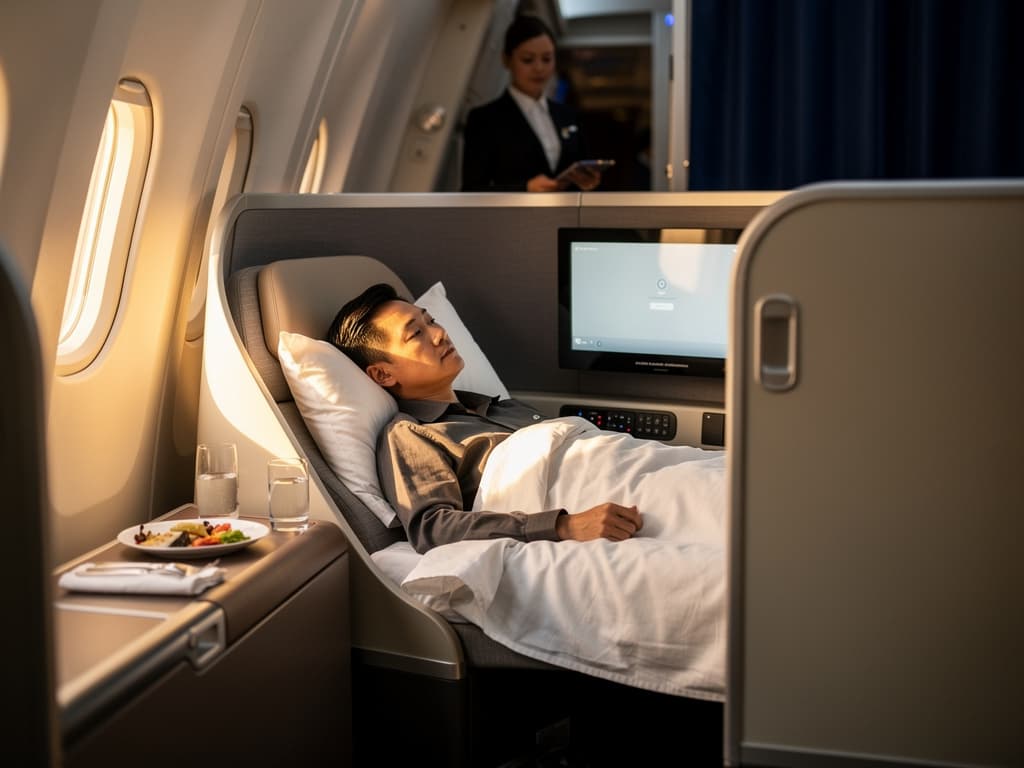
Lufthansa Allegris, now deploying on newly delivered Airbus A350 and Boeing 787 aircraft, is the most architecturally ambitious product on this list. Seven distinct seating configurations within a single business class cabin — including a Suite variant with chest-high walls and a 86-inch (218 cm) bed — give passengers genuine choice rather than a single standardized experience. Heating and cooling cushions integrated directly into the seat address one of the most persistent complaints in long-haul travel: the inability to regulate personal temperature during overnight crossings. Full technical specifications are available via Business Traveller’s first-look review of the Allegris cabins.
Air France‘s new business suite, now installed on 12 Boeing 777-300ER aircraft, takes a more refined approach. The sliding privacy door, nearly 7-foot flat bed, and 17.3-inch 4K anti-glare screen are paired with Bluetooth audio and 60W USB-C charging — a combination that prioritizes intuitive usability over sheer scale.
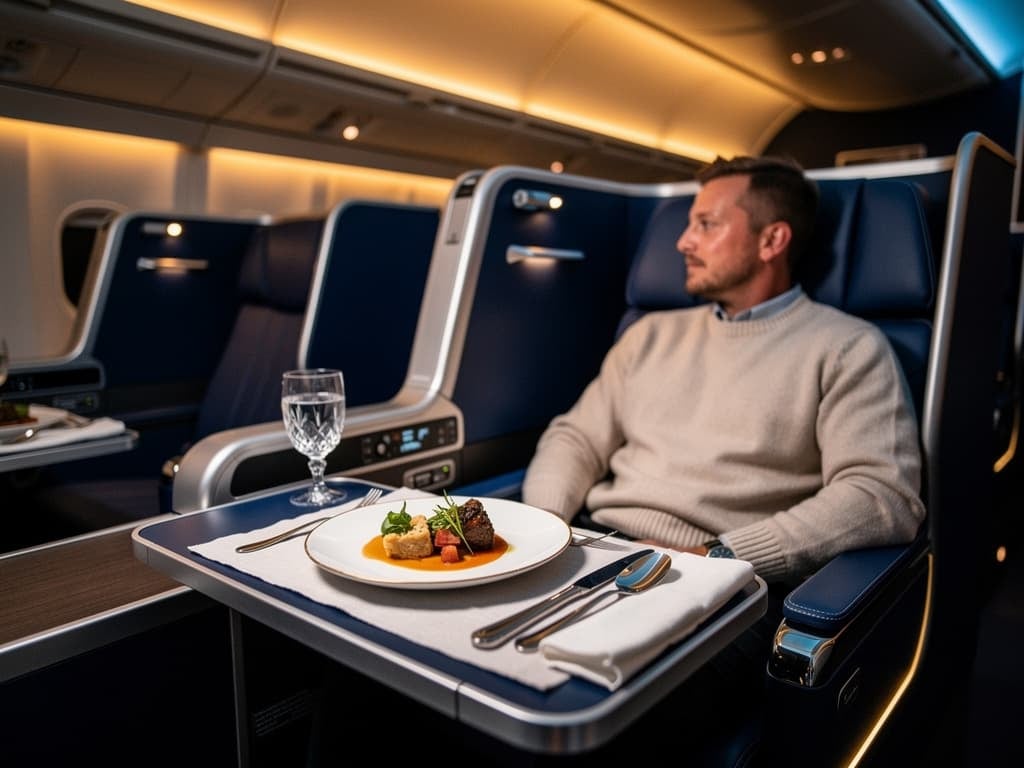
United Airlines‘ Polaris Studio occupies a category of its own among US carriers. The eight bulkhead suites on the Elevated Boeing 787-9 offer 25% more living space than standard Polaris pods, a companion ottoman for shared dining, and that 27-inch (68.5 cm) 4K OLED screen — a specification that no other American carrier currently matches. Ossetra caviar and Laurent-Perrier Rosé Champagne complete what amounts to a first-class-lite experience at a flat $499 upgrade fee above the base business fare.
American Airlines‘ Flagship Suite, built on the Adient Ascent platform, brings the carrier into alignment with global privacy standards for the first time. The reverse herringbone layout, 79-inch flat bed, and full-height doors are now appearing on the 787-9P subfleet and rolling out to the 777-300ER under Project Olympus. Japan Airlines‘ A350-1000 suite — with its Safran Euphony headrest speakers, 24-inch 4K monitor, and private wardrobe — sets the technology benchmark for the Asia market. Cathay Pacific‘s Aria Suite on the 777-300ER, built on the Collins Aerospace Elements platform, delivers a 78-inch bed and a 24-inch 4K display within a quiet-luxury aesthetic of cream and taupe. Turkish Airlines‘ Crystal suite finally replaces the carrier’s outdated 2-3-2 configuration with a 1-2-1 layout, a 23-inch seat width, and the airline’s first-ever adjustable privacy door. And Qatar Airways‘ Qsuite Next Gen — designed for the incoming Boeing 777-9 but debuting on the A350-1000 — raises suite walls by two inches, expands the bed to 23 inches wide, and introduces motorized screens that slide aside to create the largest shared social space in commercial aviation.
| Airline / Product | Aircraft | Bed length | Screen size | Privacy door | Standout feature |
|---|---|---|---|---|---|
| Lufthansa Allegris | A350 / 787 | 79–86 in (201–218 cm) | 18 in (46 cm) 4K | Yes (Suite tier) | 7 seat configurations; heated/cooled cushions |
| Air France New Business Suite | 777-300ER (12 aircraft) | ~84 in (213 cm) | 17.3 in (44 cm) 4K | Yes (sliding) | Bluetooth audio; 60W USB-C |
| United Polaris Studio | 787-9 (bulkhead) | Standard Polaris | 27 in (68.5 cm) 4K OLED | Yes (sliding) | Largest screen on US carrier; caviar service |
| American Flagship Suite | 787-9P / 777-300ER | 79 in (201 cm) | 17.5 in (44.5 cm) 4K HDR | Yes (full-height) | Chaise lounge mode; Bluetooth audio |
| JAL A350-1000 Suite | A350-1000 | Not specified | 24 in (61 cm) 4K | Yes (full-height) | Safran Euphony headrest speakers; private wardrobe |
| Cathay Pacific Aria Suite | 777-300ER | 78 in (198 cm) | 24 in (61 cm) 4K | Yes (sliding) | 60W USB-C; gallery artwork; custom lighting |
| Turkish Airlines Crystal | 777-300ER | Not specified | 22 in (56 cm) 4K | Yes (full-height) | 23 in (58.4 cm) seat width; flying chef service |
| Qatar Qsuite Next Gen | A350-1000 / 777-9 | Extended hip/shoulder width | Motorized 4K OLED (slidable) | Yes (raised 2 in) | Quad suite modularity; Starlink WiFi |

Flight deals most people never see
Our AI monitors 150+ airlines for pricing anomalies that traditional search engines miss. Air Traveler Club members save $650 per trip per person on average: see how it works.
Each deal saves 40–80% vs. regular fares:

Where these eight products actually sit in the competitive landscape
The 2026 upgrade cycle has compressed the gap between mid-tier and elite business class products — but it has not eliminated it. Understanding where each product sits relative to its direct competitors on specific routes is what separates a good booking decision from a great one.
On transatlantic routes, Lufthansa Allegris edges Air France‘s new suite on raw bed length — 86 inches versus approximately 84 inches — and wins decisively on configuration variety. But United Polaris Studio‘s 27-inch screen makes it the most visually immersive option on North America-Europe sectors, particularly for passengers who prioritize entertainment over maximum sleep surface.
The Asia market is where the technology gap is most pronounced. JAL‘s Safran Euphony headrest speakers represent a genuine innovation — one that Cathay Pacific‘s Aria Suite, for all its elegance, does not yet match. Both carriers offer 24-inch 4K displays and full-height doors, but JAL’s private wardrobe and under-seat carry-on storage solve friction points that Cathay’s slightly constrained footwell does not.
On the Europe-Middle East corridor, Turkish Airlines Crystal has executed the most dramatic single-product improvement of any carrier in recent memory — moving from a 2-3-2 middle-seat configuration to a 1-2-1 suite with a 23-inch (58.4 cm) seat width. That width matches Qatar Airways Qsuite Next Gen in the upright position, though Qatar’s motorized slidable screens and quad-suite modularity remain in a category of their own. Air Traveler Club’s mixed-cabin booking framework for international business class is worth consulting when award availability on these new products appears limited — particularly for transpacific JAL and Cathay sectors where automated search tools frequently suppress valid itineraries.
The historical parallel is instructive. When Qatar Airways introduced the original Qsuite in 2017, competitors took roughly two years to achieve privacy parity — and early adopters on Europe-Middle East routes captured a measurable yield premium during that window. The carriers that moved fastest on doors and 4K screens in 2019–2021 are the ones now competing at the top of this list. The carriers still running 2-2-2 open cabins are not.
How to lock in these new cabins before peak demand absorbs inventory
The booking window for newly delivered aircraft and active retrofits is narrow — and the carriers running these products know it. Acting at the 330-day mark is not a suggestion; it is the practical threshold before elite-tier upgrade waitlists and revenue bookings compress available award space on high-demand routes.
- Search by aircraft type, not just route. Lufthansa Allegris operates on specific A350 and 787 deliveries — not every Frankfurt or Munich departure. Use seat map tools to confirm the aircraft before booking. The same applies to United‘s Elevated 787-9, which currently operates select San Francisco-Singapore and San Francisco-London Heathrow rotations.
- Book Polaris Studio at the flat $499 upgrade fee. United prices the Studio upgrade as a fixed add-on above the base Polaris fare, making it one of the most predictable premium upgrades in the market. Availability opens with the booking window — not at check-in.
- Use ExpertFlyer J-class alerts for Air France and Cathay retrofits. The Air France 777 suite and Cathay Aria are rolling out across specific tail numbers, not entire fleets. Award space on these aircraft is tighter than on legacy configurations and rarely surfaces in standard search.
- Star Alliance Gold and Oneworld Emerald status holders should activate upgrade waitlists immediately. Priority allocation on Lufthansa Allegris Suite tiers and JAL A350-1000 suites goes to top-tier elites first. Waitlist positions fill within days of the booking window opening on peak-season departures.
- Watch for Boeing 777-9 delivery confirmation from Qatar Airways in late 2026. If the 777-9 enters service on schedule, Qsuite Next Gen scales to a full quad-suite 1-2-1 configuration with Starlink WiFi — at which point competing Star Alliance and Oneworld carriers will face renewed pressure to accelerate their own A350 and 787 retrofit timelines.
Midweek departures in Q3 — outside peak summer travel — offer the best combination of cash fare discounts and award availability on these new products. The window before Q4 holiday demand is the optimal entry point for first-time bookings on any of the eight cabins listed here.
FAQ
Which of these eight business class products offers the best sleep experience for tall passengers?
Lufthansa Allegris Suite and Extra Long variants offer the longest beds at 86 inches (218 cm), specifically engineered with a specialized footwell for taller flyers. Qatar Qsuite Next Gen adds four additional inches of lateral hip and shoulder space in bed mode, reducing the confined sensation common in high-walled suites. For passengers over 6’3″, these two products represent the clearest choices on transatlantic and Europe-Middle East routes respectively.
Is the United Polaris Studio worth the $499 upgrade fee over a standard Polaris seat?
The $499 flat fee buys a 25% larger living space, a 27-inch 4K OLED screen versus 19 inches in standard Polaris, a companion ottoman, and elevated catering including Ossetra caviar and Laurent-Perrier Rosé Champagne. On a 10-plus-hour sector — San Francisco to Singapore or London — the per-hour cost is under $50 for a materially superior experience. The Studio is currently limited to eight seats on select Elevated 787-9 rotations, so availability is the primary constraint, not value.
Does Japan Airlines’ Safran Euphony headrest speaker system work as well as noise-canceling headphones?
The Safran Euphony system delivers high-fidelity audio through speakers built directly into the seat headrest, eliminating physical fatigue from wearing headphones across long overnight sectors. It does not provide active noise cancellation in the traditional sense — ambient cabin noise remains audible — but the directional audio quality is engineered to compensate for background noise at typical cabin decibel levels. Passengers sensitive to engine noise may still prefer personal noise-canceling headphones for sleep, but for film and music consumption the system represents a genuine ergonomic improvement over wired or wireless headsets worn for eight or more hours.
Read more