Summary
United Airlines is reshaping its global long-haul network at both extremes, launching a new daily Newark–Seoul nonstop on September 4, 2026 while slashing San Francisco–Adelaide to a six-week seasonal window after first-season seat factors plunged to 33.7% in February. The carrier now operates an industry-leading 152 long-haul departures per day, with one in every 18 flights classified as long-haul.
The Newark–Seoul route deploys a 257-seat Boeing 787-9 with Polaris and Premium Plus inventory in a market where average base fares run nearly half those from JFK. Adelaide’s truncated December 17–February 8 window signals how quickly ultra-long route economics force capacity corrections.
Two trajectories are unfolding simultaneously across United’s transpacific network. On September 4, the carrier inaugurates daily Newark–Seoul service — its third nonstop from Newark to East Asia — inserting Polaris-equipped Boeing 787-9 capacity into a market that has quietly become the airport’s largest East Asian destination by passenger volume. Meanwhile, San Francisco–Adelaide, launched with fanfare in December 2025, is contracting to roughly six weeks of flying after delivering a 52.7% seat factor in its debut season.
The divergence captures the physics of ultra-long-haul route economics. Newark–Seoul enters a proven demand pool: 179,000 round-trip passengers flew the city pair in the twelve months through June 2026, outpacing Newark–Tokyo traffic. Adelaide, by contrast, represents the riskier frontier — a brand-new nonstop market where 11,778 round-trip passengers materialized but not enough to sustain a full seasonal schedule.
For premium travelers, the implications are concrete. Newark-based flyers gain a year-round Polaris option to Seoul at fare levels well below JFK’s Asiana-Korean Air duopoly. San Francisco–Singapore remains the crown jewel — twice-daily 787-9 service with 64 Polaris seats per departure, the carrier’s largest front-cabin footprint on any aircraft. Australia-bound passengers retain multiple premium nonstop options through Melbourne and Sydney, though Adelaide now requires precise calendar targeting.
Route-by-route breakdown
United’s eleven longest nonstop routes, measured by maximum block time between August and December 2026, reveal a network anchored by Pacific and Southern Hemisphere flying. Block time — gate-to-gate measurement including taxiing, flight time, and delay padding — stretches to 17 hours 40 minutes on San Francisco–Singapore, the carrier’s longest scheduled operation.
Houston–Sydney reaches 17 hours 35 minutes northbound, while Delhi–Newark clocks 17 hours westbound. Johannesburg–Newark, Los Angeles–Hong Kong, and both Cape Town routes all exceed 16 hours. Newark–Seoul enters the list at 15 hours 55 minutes, matching San Francisco–Melbourne’s block time.
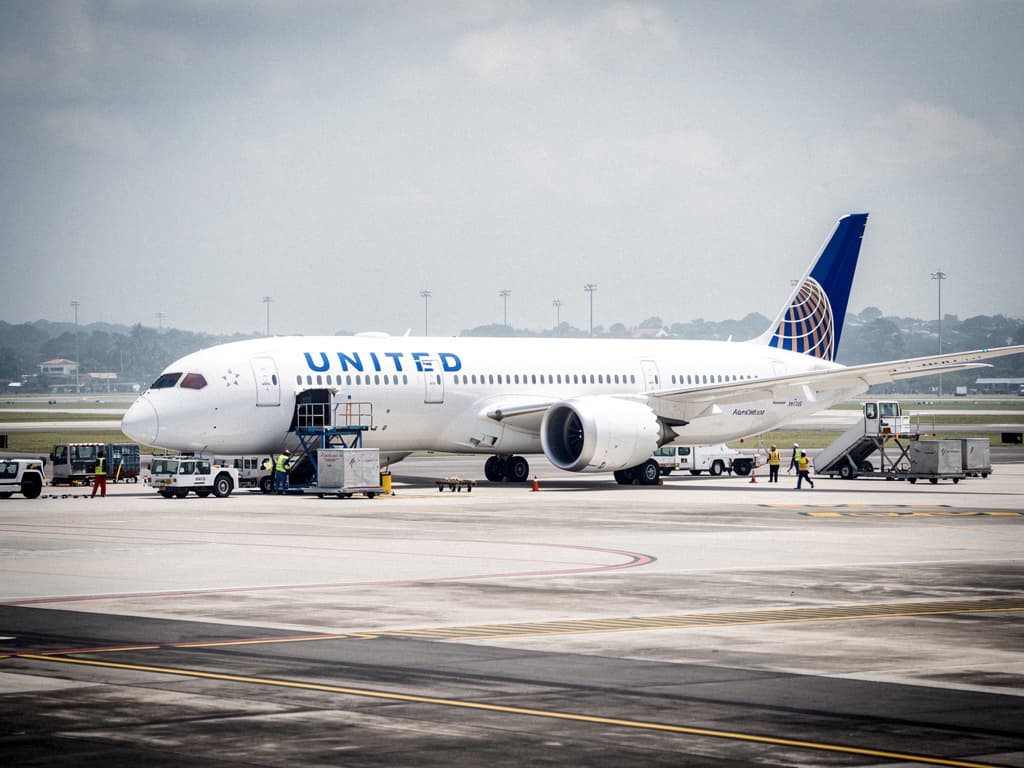
The fleet backbone across these missions is the Boeing 787-9, deployed in two configurations. The premium-heavy 222-seat variant — with 64 Polaris suites, 35 Premium Plus recliners, and 123 economy seats — serves San Francisco–Singapore exclusively. Most other ultra-long routes use the higher-density 257-seat layout, which Newark–Seoul will receive.
| Route | Max Block Time | Frequency | Aircraft |
|---|---|---|---|
| San Francisco–Singapore | 17h 40m | Twice daily | 787-9 (222-seat) |
| Houston–Sydney | 17h 35m | Daily (seasonal) | 787-9 |
| Delhi–Newark | 17h 00m | Daily | 787-9 |
| Johannesburg–Newark | 16h 25m | Up to daily | 787-9 |
| San Francisco–Adelaide | 16h 20m | Three weekly (seasonal) | 787-9 |
| Los Angeles–Hong Kong | 16h 10m | Twice daily | 787-9 |
| Cape Town–Washington Dulles | 16h 05m | Three weekly | 787-9 |
| Cape Town–Newark | 16h 00m | Up to four weekly | 787-9 |
| Los Angeles–Melbourne | 16h 00m | Up to daily | 787-9 |
| San Francisco–Melbourne | 15h 55m | Daily | 787-9 |
| Newark–Seoul Incheon | 15h 55m | Daily (new) | 787-9 (257-seat) |

Flight deals most people never see
Our AI monitors 150+ airlines for pricing anomalies that traditional search engines miss. Air Traveler Club members save $650 per trip per person on average: see how it works.
Each deal saves 40–80% vs. regular fares:

What Adelaide’s retreat signals about ultra-long route risk
The Adelaide contraction is the more instructive story for understanding ultra-long-haul economics. Launching a brand-new nonstop market spanning 16-plus hours requires substantial route support funding — South Australia’s tourism commission almost certainly backstopped the inaugural season. When February 2026 delivered a 33.7% seat factor, the math became untenable.
United’s response — compressing the operating window to December 17 through February 8 — concentrates flying on peak Australian summer demand while abandoning shoulder-season months that dragged down first-season averages. The strategy mirrors what airlines have done with other marginal ultra-long routes: protect the core demand period, sacrifice the rest. Whether six weeks of flying generates sufficient yield improvement to justify continuation remains the open question. Air Traveler Club’s analysis of United’s premium 787-9 deployment strategy shows how the carrier allocates its most valuable cabin real estate — and Adelaide didn’t make the cut for the premium-heavy configuration.
How to position for Newark–Seoul and Adelaide availability
Newark–Seoul launch-period premium inventory will tighten quickly — new long-haul routes typically see Polaris award space absorbed within days of schedule publication, particularly for peak travel windows. Adelaide’s compressed six-week season means every departure matters; there is no shoulder period to absorb spillover demand.
- Monitor United.com immediately for Newark–Seoul award space. Launch routes often release saver-level Polaris inventory in the first scheduling cycle, but it vanishes fast — especially on a route where JFK alternatives command nearly double the base fare.
- Adelaide bookings require precision. With only six weeks of operation, target mid-January through early February departures when Australian summer demand peaks but before the route terminates on February 8.
- Consider positioning through San Francisco for Singapore. The twice-daily 787-9 schedule with 64 Polaris seats per departure offers substantially more premium inventory than any single-daily ultra-long route, making award space more accessible year-round.
- Air Premia’s presence on Newark–Seoul creates a pricing floor. United’s premium cabin fares will need to compete against the incumbent’s lower-fare model, potentially keeping Polaris pricing more accessible than on JFK–Seoul nonstops.
- Watch for MileagePlus dynamic pricing on these routes. United’s award pricing algorithm responds to cash fare movements — if Newark–Seoul base fares stay low relative to JFK, expect correspondingly lower award rates compared to other Asia gateway routes.
FAQ
When does United’s Newark–Seoul route launch and what aircraft will operate it?
United Airlines inaugurates daily Newark–Seoul Incheon service on September 4, 2026, using a 257-seat Boeing 787-9 configured with Polaris business class and Premium Plus cabins. It becomes the carrier’s third nonstop from Newark to East Asia.
Why did United reduce San Francisco–Adelaide to a six-week season?
The route’s first season delivered a 52.7% seat factor overall, with February 2026 dropping to 33.7%. United responded by compressing the second season to December 17, 2026 through February 8, 2027, concentrating operations on peak Australian summer demand and eliminating shoulder-season flying that depressed first-season results.
Which United route has the longest block time in the current schedule?
San Francisco–Singapore holds the top position at 17 hours 40 minutes maximum block time, operated twice daily with United’s premium-heavy 222-seat Boeing 787-9 configuration featuring 64 Polaris suites per departure.
Read more