Summary
Eight years after its 2018 debut review, United Airlines‘ Polaris business class on the Boeing 777-300ER operating UA869 from San Francisco to Hong Kong remains structurally unchanged — the same Safran Optima-platform seat, the same 1-2-1 configuration, the same 78-inch lie-flat bed across 60 seats in two cabins. What has changed substantially is the soft product: catering has improved from serviceable to genuinely impressive, the wine program now features bottles retailing at $75–$150, and mid-flight tapas have replaced a basic buffet.
Wi-Fi reliability on the 777 fleet remains a persistent weakness — the $17.99 flight pass was inoperative for most of the January 30, 2026 flight, prompting a proactive refund. Starlink deployment on older widebodies cannot arrive soon enough.
The same aircraft, the same route, the same flight number — and nearly the same seat. When United Airlines launched Polaris in late 2016, it represented a genuine step forward for a carrier that had long trailed Asian and Gulf competitors on long-haul premium product. The question worth asking in 2026 is whether that step has become a stride, or whether United has been standing still while rivals sprint ahead.
The answer, based on a January 30 flight aboard UA869 from San Francisco to Hong Kong, is nuanced. The hard product — seats, bedding, cabin layout — is essentially frozen in amber since 2018. But the soft product has evolved meaningfully, and on a 14-hour, 40-minute flight covering 6,927 miles, the quality of food and service matters as much as the seat dimensions.
Seat 18A, a window position in the last row of the rear Polaris cabin, tells the full story. The purser introduced herself within minutes of boarding and acknowledged the passenger’s Premier 1K status — a small touch that signals the service culture United has been cultivating. What followed was a meal service that genuinely surprised, a nap enabled by Saks Fifth Avenue bedding, and a connectivity experience that frustrated. That tension — a product improving in some dimensions while stalling in others — defines where Polaris sits in the competitive landscape today.
The details: what eight years of Polaris looks like in 2026
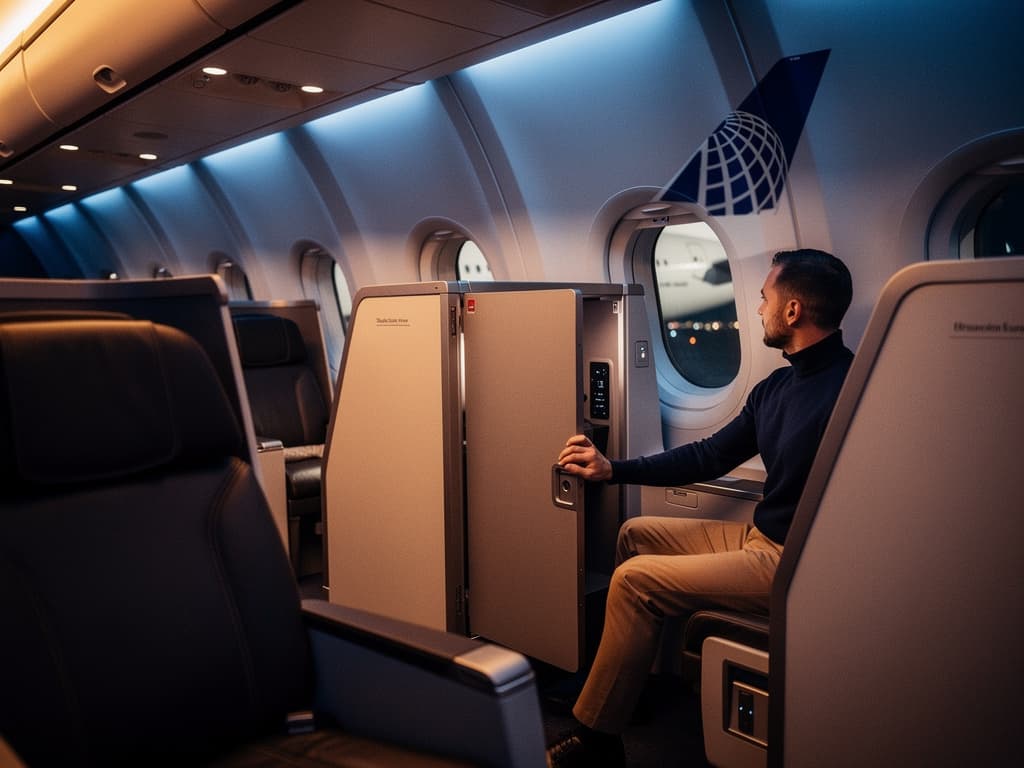
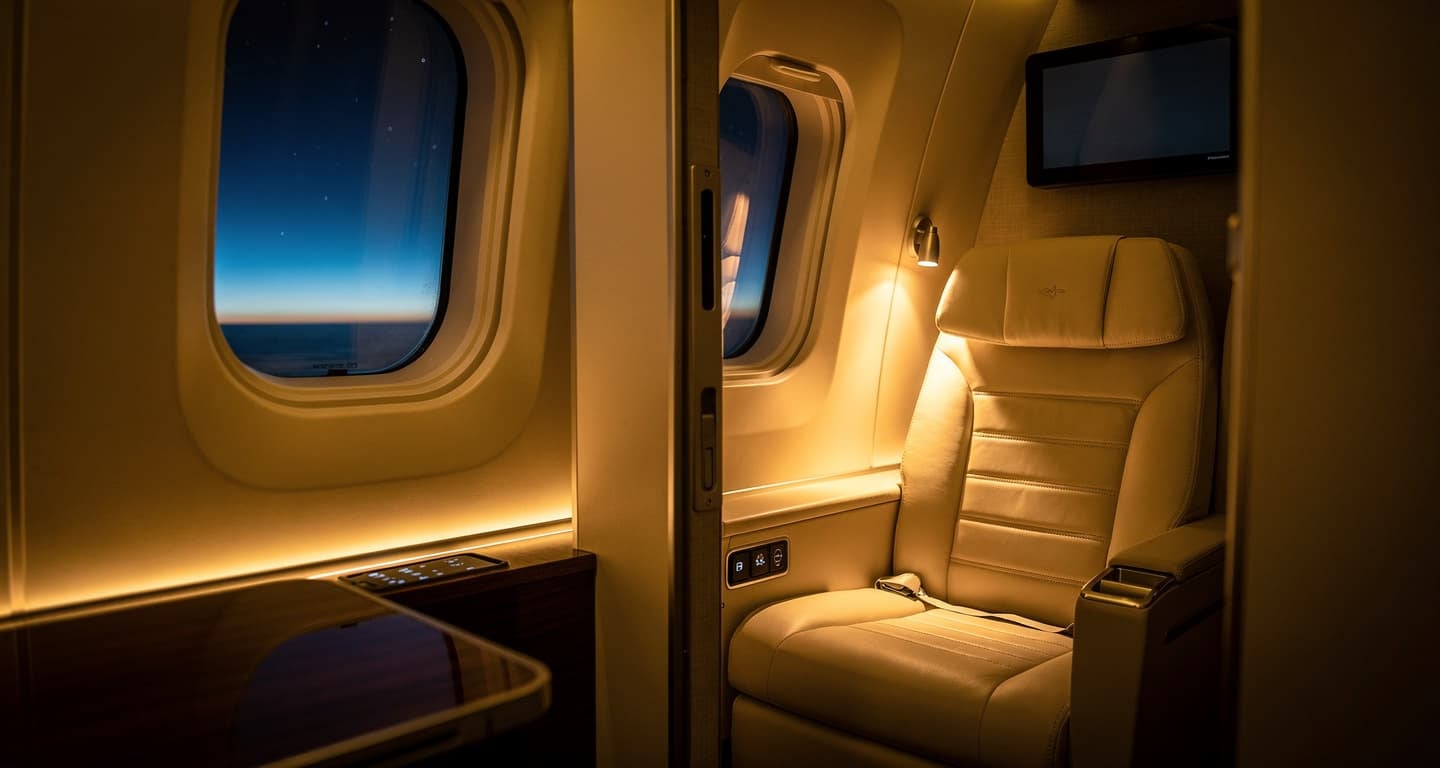
The 777-300ER Polaris cabin divides into two sections: rows 1–8 forward and rows 9–18 aft, all in a 1-2-1 configuration with every seat offering direct aisle access. Odd-numbered A and L positions are true window seats — the most private option on the aircraft — while the center D and G “honeymoon” pairs suit couples traveling together, with a privacy divider available for solo occupants. Bulkhead rows 1 and 9 offer wider footwells and represent the best seats on the aircraft; 9L and 9A are the top picks for solo travelers prioritizing privacy and space.
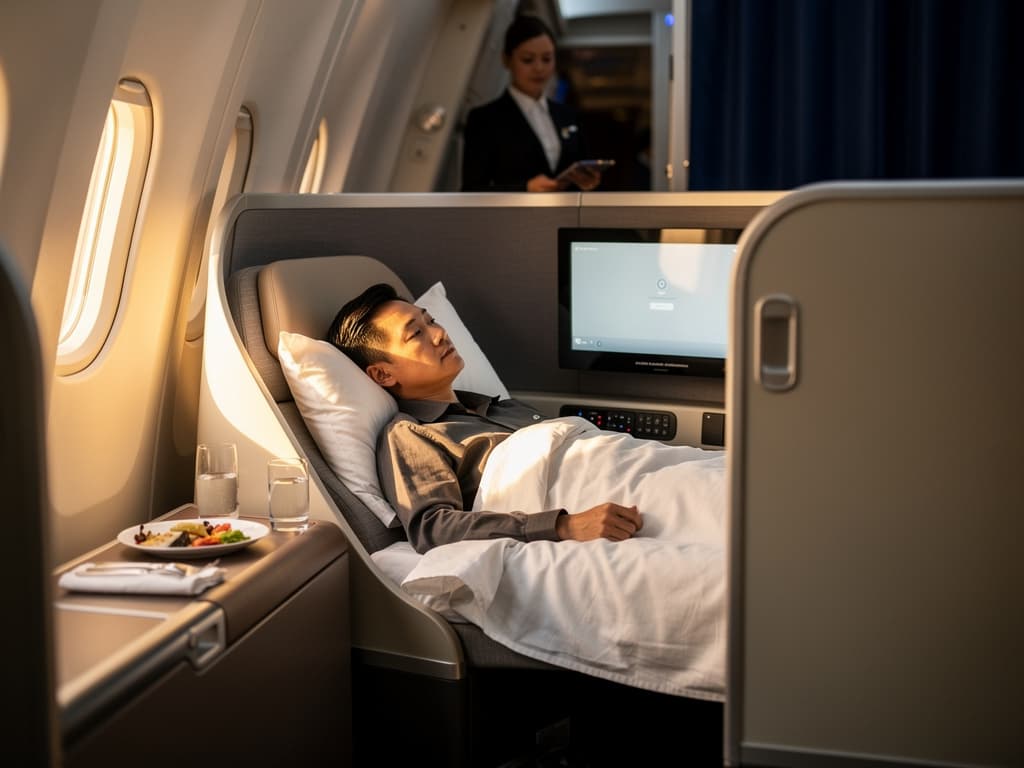
The seat itself measures 20 inches wide and converts to a 78-inch lie-flat bed. Each position includes a universal AC outlet, USB-A charging, and individual air vents — the latter a genuine comfort advantage on a long overnight-adjacent flight. Saks Fifth Avenue bedding includes a blanket, duvet, cooling foam gel pillow, and larger pillow at the seat; mattress pads are available on request and United now theoretically stocks enough for every passenger, though requesting one immediately after boarding remains advisable.
The food program is where 2026 diverges most sharply from 2018. Lunch opened with an Aperol Spritz and warmed mixed nuts — a small but telling signal of how the beverage program has matured. The main course, a Chilean sea bass with orange-Aleppo roasted fennel, saffron farro risotto, and cioppino broth, was cooked correctly and plated with care. The wine list featured a Domaine Serene “Evenstad Reserve” Chardonnay (2023) retailing at $75 and a Mascot Cabernet Sauvignon at approximately $150 per bottle. Mid-flight “tapas” — black bean corn empanadas, brown butter gnocchi, herb ricotta — arrived in entree-sized portions, a meaningful upgrade from the 2018 buffet of sandwiches and leftover desserts. A full pre-arrival breakfast rounded out three distinct meal services.
The one consistent failure: Wi-Fi. The $17.99 flight pass was inoperative more than it functioned, and United issued a proactive refund post-flight. This is a recurring pattern on the older 777 fleet, and it represents the single largest gap between Polaris and competitors who have prioritized connectivity infrastructure.
| Category | 2018 experience | 2026 experience | Verdict |
|---|---|---|---|
| Seat/bed | 20″ wide, 76″ lie-flat, 1-2-1 | 20″ wide, 78″ lie-flat, 1-2-1 | Marginally improved |
| Bedding | Saks Fifth Avenue; mattress pad limited stock | Saks Fifth Avenue; mattress pad now stocked for all | Improved availability |
| Main course | Pork tenderloin; fish historically disappointing | Chilean sea bass cooked correctly; strong execution | Significantly improved |
| Wine program | No wine list offered; basic selections | $75–$150 retail bottles; Domaine Serene, The Mascot | Major upgrade |
| Mid-flight dining | Buffet: sandwiches, fruit, grilled cheese on request | Tapas service: empanadas, gnocchi, ricotta (entree-sized) | Upgraded format |
| Headphones | Basic noise-cancelling; poor quality | Meridian Audio noise-cancelling; significant sound upgrade | Improved |
| Wi-Fi | $36.99 pass; worked first half only | $17.99 pass; mostly inoperative, refund issued | Still unreliable |
| Amenity kit | Special-edition United 747 kit | Brooks Brothers kit; Perricone MD skincare | Comparable |

Flight deals most people never see
Our AI monitors 150+ airlines for pricing anomalies that traditional search engines miss. Air Traveler Club members save $650 per trip per person on average: see how it works.
Each deal saves 40–80% vs. regular fares:

The value-add: where Polaris stands in the competitive picture
Polaris occupies a specific and defensible position in the trans-Pacific business class market — not the most private, not the most spacious, but competitive on schedule, price, and the MileagePlus ecosystem. The SFO–HKG route is one of United’s strongest, operating daily on the 777-300ER with a schedule that suits both westbound overnight and eastbound daytime preferences.
The cabin’s core weakness relative to Cathay Pacific‘s Aria Suite on the same route is privacy. Cathay’s reverse-herringbone product with suite doors creates a genuinely enclosed environment; Polaris does not. ANA‘s “The Room” on competing routes offers more floor space. Against those benchmarks, United competes on price — cash fares on Polaris typically undercut Cathay on this routing — and on award availability through Star Alliance partners.
It’s worth noting that the Polaris Lounge access picture at SFO has shifted. Air Traveler Club’s reporting on United’s April 2026 lounge access restrictions details how Star Alliance business class passengers on carriers including Singapore Airlines and Turkish Airlines now receive only United Club access at U.S. hubs — a meaningful pre-flight downgrade for those connecting onto UA869 from partner metal.
The Starlink question looms over everything. If United deploys satellite connectivity across the 777 fleet on a meaningful timeline, the reliability gap closes and Polaris becomes a more complete product. Until then, passengers who depend on in-flight connectivity for work should factor the current Wi-Fi track record into their routing decisions.
How to position a Polaris booking on this route in 2026
This is a travel-intel story rather than a time-sensitive booking event, but the 2026 vs. 2018 comparison surfaces several practical considerations worth acting on.
- Seat selection matters more than on most aircraft: Rows 9A and 9L are the optimal solo seats — bulkhead position with true window privacy. Book these at the 330-day window when they open; they clear quickly on a popular route.
- Pre-order the fish: The Chilean sea bass on the January 2026 menu was the standout dish — and the oak-roasted salmon appetizer sold out before the galley reached row 18. Pre-ordering via the United app locks in first choice before boarding.
- Request the mattress pad immediately: United now stocks enough for every Polaris passenger, but the practice of requesting it at boarding remains the safest approach. Don’t wait for the crew to offer.
- Plan around Wi-Fi dependency: The $17.99 flight pass on the 777 fleet is unreliable. Download content offline before departure; treat any connectivity as a bonus rather than a given until Starlink deployment is confirmed for this aircraft type.
- Award space on SFO–HKG is tight: MileagePlus saver awards on this route require early searches — the 3-to-11-month booking window captures most release patterns. United’s award search tool shows real-time Polaris availability; Premier 1K members can call the dedicated desk for waitlist positioning.
Watch for United’s Starlink rollout timeline on the 777 fleet. An official deployment announcement covering the 777-300ER would meaningfully change the calculus for connectivity-dependent travelers on this 15-hour routing.
FAQ
How does United Polaris on the 777-300ER compare to the newer 787-9 Polaris product?
The 787-9 Polaris cabin carries 64 seats versus 60 on the 777-300ER, but uses the same 1-2-1 seat pod design. United’s Elevated 787-9 configuration, launched April 22, 2026, introduces eight front-row Polaris Studios with sliding privacy doors and 27-inch 4K OLED screens — a meaningfully different product from the standard Polaris pod on either aircraft. The 777-300ER operates UA869 SFO–HKG; the Elevated 787-9 currently serves SFO–Singapore and SFO–London Heathrow.
Is Polaris Lounge access at SFO guaranteed when flying UA869?
Access to the Polaris Lounge at SFO is guaranteed for passengers booked in Polaris business class on United metal. However, as of April 14, 2026, Star Alliance business class passengers connecting from partner carriers are restricted to United Club access unless flying on one of five designated partners: ANA, Air New Zealand, ITA Airways, or the Lufthansa Group. Passengers on Singapore Airlines, Turkish Airlines, and several other Star Alliance carriers no longer qualify for Polaris Lounge access at U.S. hubs.
What are the best seats in United Polaris on the 777-300ER for a solo traveler?
Seats 9L and 9A are the top picks — bulkhead row in the rear cabin with true window privacy (solid sidewall, no end-table against the fuselage) and wider footwells than non-bulkhead rows. Rows 1A and 1L in the forward cabin are the equivalent forward option. Avoid even-numbered L and A seats if privacy is a priority, as those positions have an end-table rather than a window wall beside them.
Read more