Summary
EVA Air operates its Boeing 777-300ER fleet with up to 39 Royal Laurel business class seats on ultra-long-haul routes from Taipei to North America—a premium density that quietly outstrips many competitors on flights exceeding 15 hours. The 1-2-1 reverse herringbone layout guarantees direct aisle access, while seat dimensions of 60-inch pitch and 26-inch width rival top Asian carriers.
Award availability on these routes can be more accessible than on other Star Alliance carriers, but the airline’s ongoing freighter conversions and eventual shift to Airbus A350-1000s mean the window to lock in this specific high-density product is finite. Booking 3–6 months out offers the best shot at snagging a seat on the 17-hour TPE–JFK run.
On a 17-hour flight, the difference between a cramped cabin and a spacious seat is everything. EVA Air has turned that equation into a competitive weapon, packing 38 or 39 business class seats into its Boeing 777-300ER aircraft—a figure that dwarfs the premium cabin density of many peers on ultra-long-haul routes. While the industry obsesses over next-generation jets, EVA’s 777s are quietly moving high-yield traffic between Taipei and North America’s biggest cities.
The numbers tell the story. On the 17-hour-15-minute haul from Taipei (TPE) to New York (JFK), EVA deploys the 777-300ER in a layout that offers nearly 40 flat-bed seats. Toronto (YYZ) at roughly 16 hours and Chicago (ORD) at 15 hours 30 minutes see the same configuration. Dallas/Fort Worth, Houston, Vancouver, and the soon-to-launch Washington Dulles route all benefit from this premium-dense strategy. For business travelers and award seekers, that means more chances to fly up front on some of the world’s longest nonstop sectors.
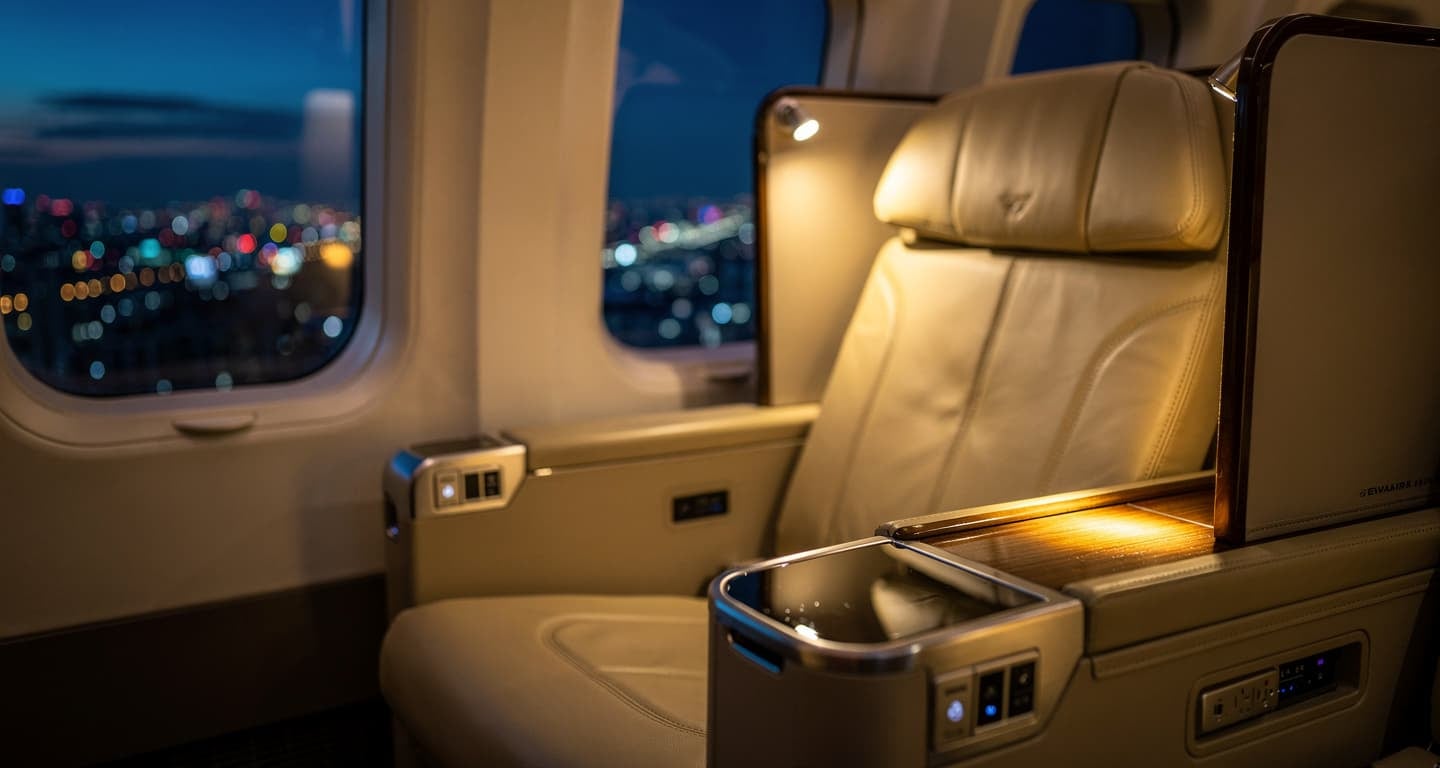
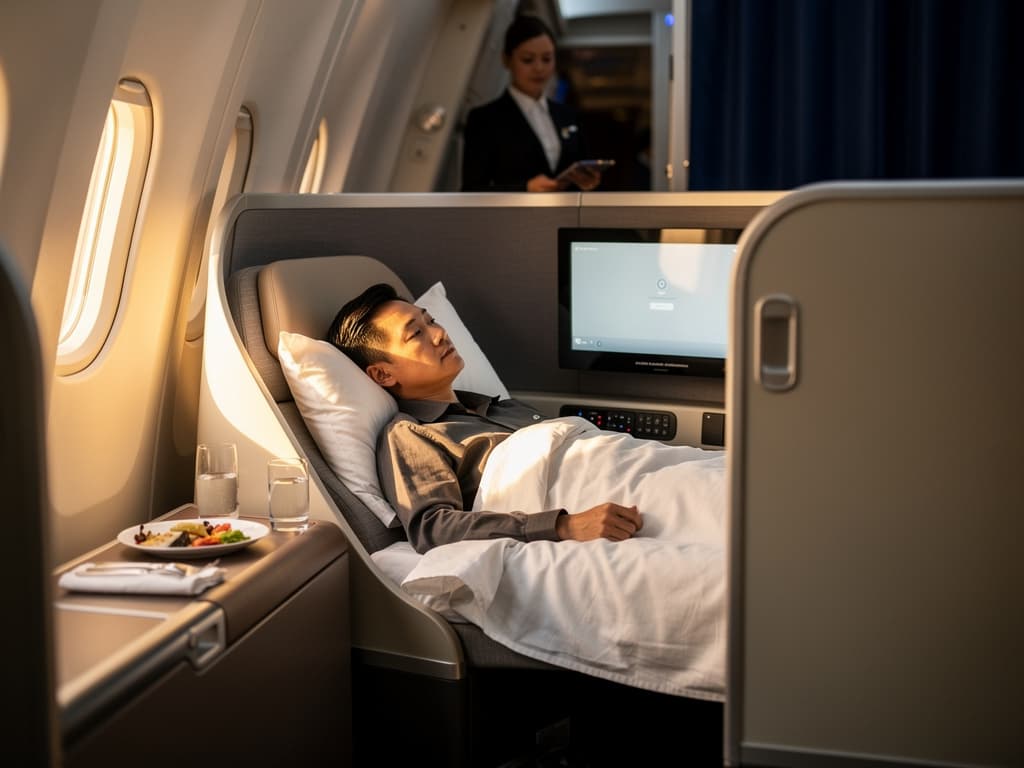
The Royal Laurel product itself is no afterthought. Each seat converts to an 82-inch fully flat bed, with 60 inches of pitch and a generous 26-inch width—dimensions that beat many 1-2-1 competitors. Direct aisle access is guaranteed, and the reverse herringbone layout provides solid privacy even without closing doors. That consistency across the fleet means passengers booking any of these North American routes know exactly what they’ll get, a rarity in an era of fragmented cabin configurations.
The details
EVA Air’s Boeing 777-300ER fleet uses three distinct layouts, all anchored by the Royal Laurel business cabin. The most common, type 77A, seats 39 passengers in business, 56 in premium economy, and 238 in economy for a total of 333 seats. Layout 77M trims business to 38 but adds more premium economy (64), while 77B keeps 39 business and expands economy to 258. The business class seat itself is the Zodiac Cirrus model, designed by BMW Designworks, and has been a workhorse for the carrier since its 777-300ER debut in July 2005.
These aircraft are the backbone of EVA’s long-haul network. The airline was a launch customer for the 777-300ER and now operates 41 Boeing 777s out of a total fleet of 89 jets (72 widebodies). However, the fleet is in transition: three 777-300ERs are being converted to freighters, and 24 Airbus A350-1000s are on order as eventual replacements. No Boeing 777X commitments have been made, signaling a future shift in premium cabin strategy. A detailed seat map of the current 777-300ER configurations is available here.
| Airline | Aircraft | Business seats | Seat pitch/width | Nonstop to East Coast? |
|---|---|---|---|---|
| EVA Air | 777-300ER | 38–39 | 60″ / 26″ | Yes (JFK, YYZ, ORD) |
| China Airlines | 777-300ER | ~34 | 60″ / 24″ | Yes (JFK) |
| United Airlines | 787-9 | 48 (Polaris) | 78″ / 22″ | No (requires SFO/LAX connection) |

Flight deals most people never see
Our AI monitors 150+ airlines for pricing anomalies that traditional search engines miss. Air Traveler Club members save $650 per trip per person on average: see how it works.
Each deal saves 40–80% vs. regular fares:

What this means for award travelers
EVA Air’s high business-class seat count isn’t just a curiosity—it directly impacts award availability. With up to 39 seats per flight on key routes, the carrier often releases more saver-level space than competitors flying smaller premium cabins. Star Alliance partners United MileagePlus and Air Canada Aeroplan are the primary booking channels, with one-way TPE–JFK awards typically ranging from 70,000 to 80,000 United miles or 65,000 to 75,000 Aeroplan points. That redemption value hovers around 1.5–1.8 cents per point, strong for ultra-long-haul flights.
The carrier’s expanding codeshare network adds another layer. Turkish Airlines recently placed its code on six EVA routes from Taipei, allowing Miles&Smiles members to earn 150% miles on business class C/J fares. Air Traveler Club’s analysis of EVA’s Star Alliance connectivity details how these partnerships can unlock even more value for premium flyers. While the Turkish codeshare focuses on regional Asian routes, the underlying Star Alliance integration means elite benefits and mileage earning extend across EVA’s entire long-haul network.
How to lock in a seat before the A350s arrive
The window to experience this specific high-density product is narrowing as EVA begins converting 777s to freighters and prepares for the A350-1000 era. For now, strategic booking can secure one of those 38–39 seats on the world’s longest flights.
- Book 3–6 months out for the best award space. TPE–JFK and TPE–ORD are the tightest routes; YVR and DFW offer more consistent availability. Use United.com or Aeroplan.ca to search, and set alerts for saver-level openings.
- Leverage transferable points. American Express transfers to Aeroplan, Chase to United. Having points in both programs gives you flexibility to grab space wherever it appears first.
- Consider cash for peak dates. If award space is gone, roundtrip business class fares around $6,500–$7,200 are competitive, especially given the seat dimensions and nonstop convenience.
- Watch the A350-1000 configuration announcement. If EVA retains 38–39 business seats on the new jet, premium density will persist. A reduction could tighten award availability significantly as the 777 fleet shrinks.
- Use Star Alliance lounges strategically. At non-Taipei airports, Royal Laurel passengers access United Clubs and other partner lounges. The United Polaris lounge at SFO is a notable perk if connecting via the West Coast.
FAQ
Which Star Alliance programs offer the best value for EVA business class awards?
Air Canada Aeroplan and United MileagePlus are the top choices. Aeroplan often charges slightly fewer points (65,000–75,000 one-way) and has flexible routing rules. United is strong for nonstop TPE–JFK/ORD redemptions at 70,000–80,000 miles. Both programs allow transfers from major bank points.
How does EVA’s older premium economy on the 777 compare to the newer 787 version?
The 777-300ER uses a previous-generation premium economy with a 2-4-2 layout, meaning not all passengers have direct aisle access. The newer 787-9 product features a 2-3-2 configuration, 42-inch pitch, 19.5-inch width, and 15.6-inch HD screens—a substantial upgrade. If premium economy is your target, aim for 787-operated routes where possible.
Will the A350-1000 replacement affect business class seat count?
EVA has not yet disclosed the A350-1000 cabin layout. If it mirrors the current 777-300ER’s 38–39 business seats, premium density will continue. A reduction would make award space harder to find as the 777 fleet shrinks. The configuration announcement, expected by 2027, is the key event to watch.
Read more