Summary
All Nippon Airways‘ The Room holds the title of the world’s widest business class seat in 2026, measuring an extraordinary 35–38 inches (89–96.5 cm) of usable horizontal space on the Boeing 777-300ER — a figure that rivals traditional first class dimensions. Singapore Airlines ranks second with 28–30 inches on its Airbus A350-900 and Boeing 777-300ER fleets, making it the widest conventional (non-suite) business class seat currently in service. Qatar Airways‘ Qsuite, Air France, and Cathay Pacific round out the top five, though all three measure between 20–23 inches — standard industry width, where privacy engineering compensates for narrower physical dimensions.
ANA’s width advantage over Qsuite is not marginal: 17 inches separates the two products. Award space on ANA 777-300ER routes is constrained, and a next-generation The Room FX rollout on 787-9s is expected in 2027.
Seat width has become the defining fault line in premium cabin competition. While the industry spent the better part of a decade racing toward enclosed suites and sliding privacy doors, a quieter revolution was underway — one measured in inches rather than amenities. The carriers that have genuinely separated themselves in 2026 are those willing to sacrifice cabin density for horizontal space, and the gap between leaders and the field is larger than most travelers realize.
ANA‘s The Room sits at the apex of this shift. At 35–38 inches wide, it occupies a category of its own — no other commercial business class product comes close. Singapore Airlines holds the second position with a 28–30 inch seat that remains the widest traditional business class configuration in service. Below them, Qatar Airways, Air France, and Cathay Pacific deliver strong, well-regarded products, but their seat widths — ranging from 20 to 23 inches — reflect standard widebody constraints rather than a deliberate push for spatial dominance.
The distinction matters most on flights exceeding ten hours, where shoulder room, sleeping surface width, and freedom of movement directly affect recovery and arrival condition. For those flying business class on ultra-long-haul routes through Asia and the Pacific, aircraft selection — not just cabin class — determines the quality of the experience.
The details: five cabins, five very different approaches to width
The ranking below is based strictly on verified physical seat width and usable personal footprint — not brand reputation, service quality, or perceived spaciousness. The spread across these five airlines is wider than the industry typically acknowledges.
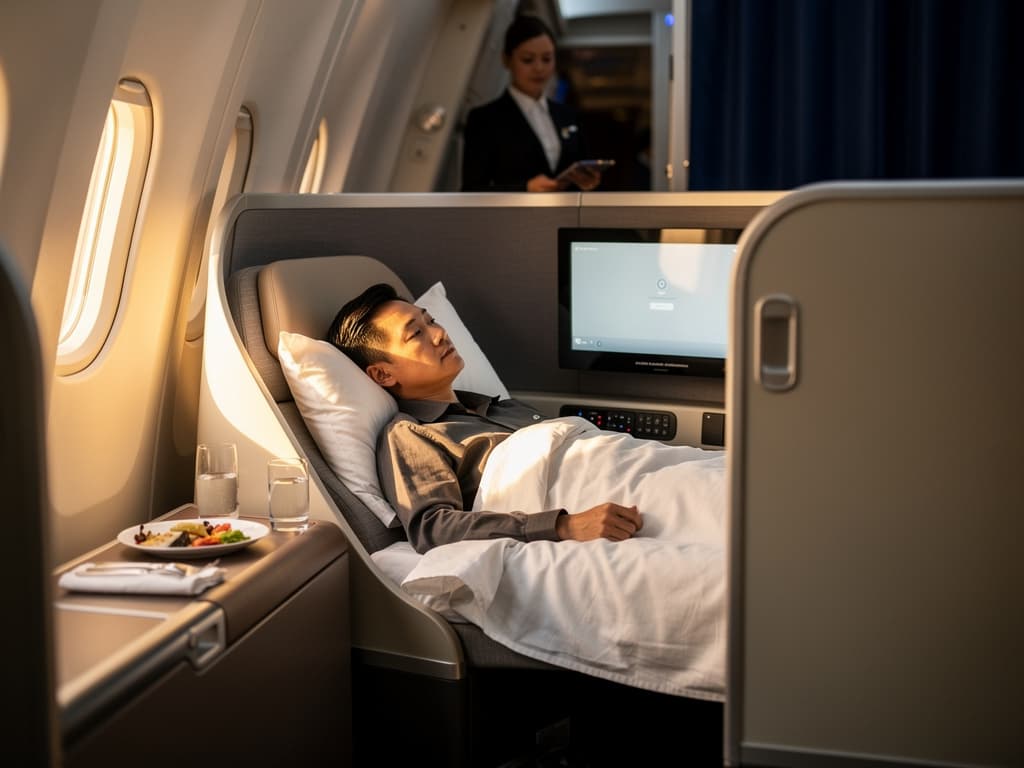
ANA‘s The Room, introduced in 2020 on the Boeing 777-300ER, broke a ceiling that had held for nearly three decades. Prior to its launch, Singapore Airlines had held the width record at approximately 28 inches on its 777 fleet. ANA’s product didn’t nudge that benchmark — it shattered it, delivering a seat that industry analysts confirm at 35–38 inches of usable horizontal space depending on measurement methodology. Sliding privacy doors are present, but they are secondary to the defining characteristic: sheer breadth. The sleeping surface is wide enough to accommodate natural lateral movement without the tapered footwells that compromise narrower lie-flat configurations. Full specifications are documented at The Flying Engineer’s 2026 widest business class seat analysis.
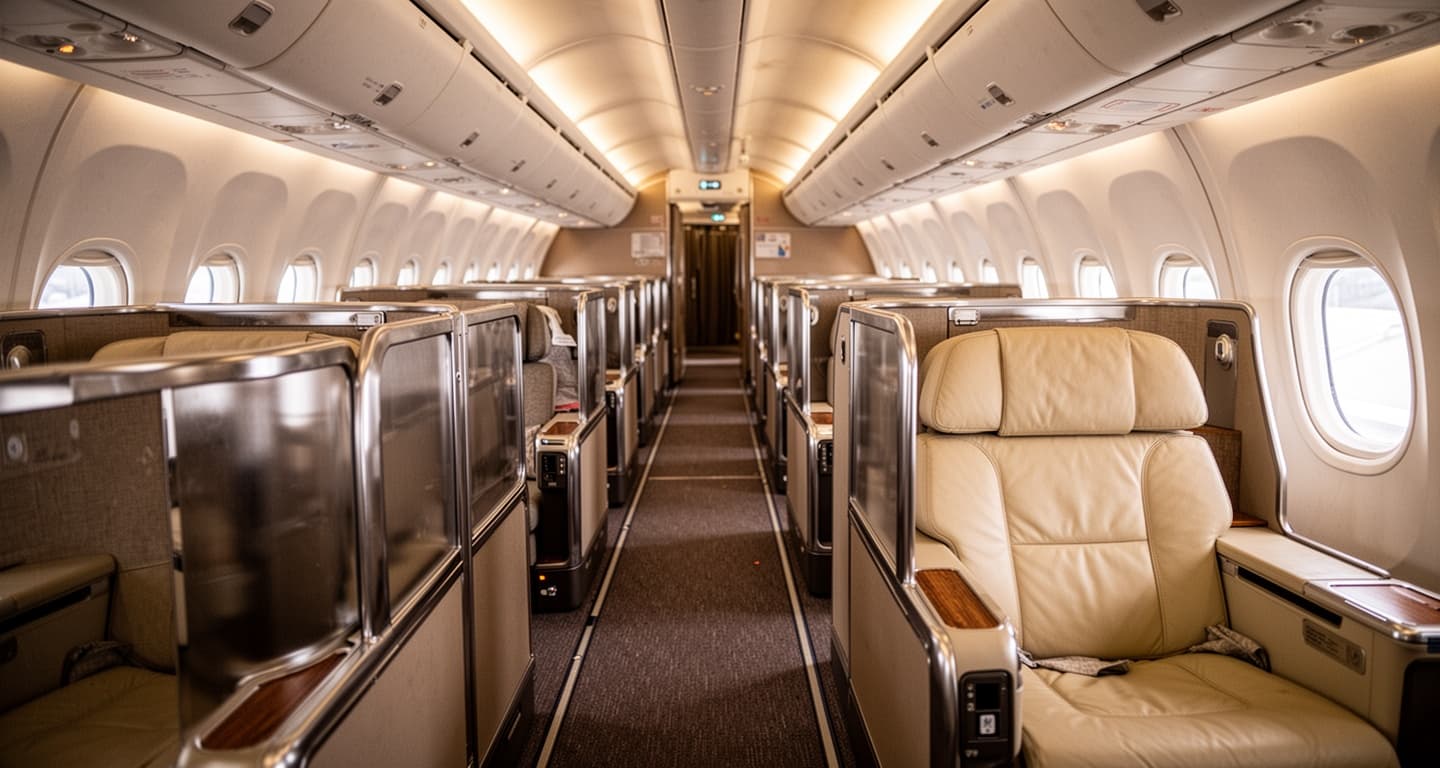
Singapore Airlines takes a philosophically different approach. Rather than enclosing passengers in suites, the carrier prioritizes open, expansive seating on both the A350-900 and 777-300ER. At 28–30 inches, the seat width is immediately apparent at the shoulders and hips — and when converted to a bed, the surface remains consistently wide across its full 78-inch length. There are no doors, no partitions, and no modular reconfiguration options. The product’s entire value proposition rests on physical comfort, and it delivers.
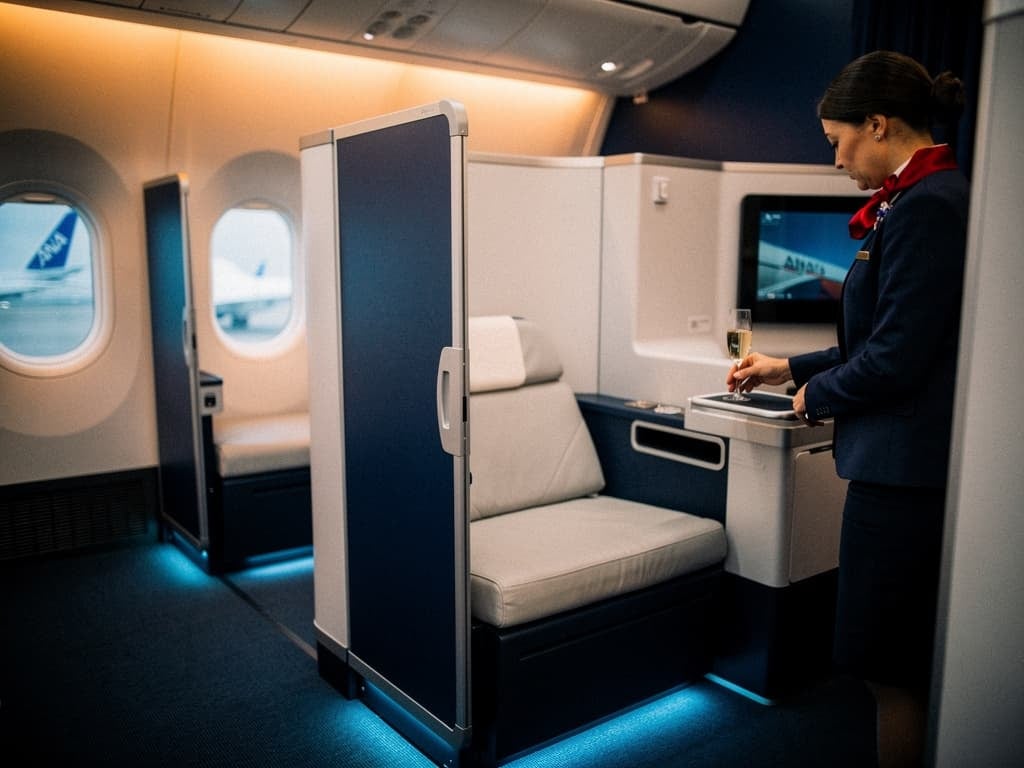
Qatar Airways‘ Qsuite presents the most interesting case study in the ranking. At 21–22 inches wide, it sits firmly within standard industry dimensions — yet it consistently ranks among the world’s best business class products. The explanation lies in spatial engineering: fully enclosed suites with sliding doors, movable privacy panels, and the ability to convert center seats into double beds or quad configurations. Qsuite doesn’t compete on width; it redefines how available space is experienced. Air France (21–23 inches) and Cathay Pacific (20–21 inches) occupy similar dimensional territory, differentiating through refinement, ergonomics, and cabin ambiance rather than horizontal scale.
| Airline | Seat product | Width (inches) | Bed length (inches) | Privacy door | Primary aircraft |
|---|---|---|---|---|---|
| All Nippon Airways | The Room | 35–38″ | 80″ | Yes (sliding) | Boeing 777-300ER |
| Singapore Airlines | Business Class | 28–30″ | 78″ | No | A350-900, 777-300ER |
| Qatar Airways | Qsuite | 21–22″ | 78″ | Yes (enclosed) | A350-1000, 777-300ER |
| Air France | Business Class | 21–23″ | ~77″ | Yes (partial) | A350-900, 777-300ER |
| Cathay Pacific | Business Class | 20–21″ | ~78″ | No (herringbone) | A350-1000, 777-300ER |

Flight deals most people never see
Our AI monitors 150+ airlines for pricing anomalies that traditional search engines miss. Air Traveler Club members save $650 per trip per person on average: see how it works.
Each deal saves 40–80% vs. regular fares:

Why width is now the real premium differentiator
Privacy doors became the dominant marketing story in business class between 2017 and 2023. Qatar Airways launched Qsuite in 2018 and shifted the entire industry’s attention toward enclosure. The result: nearly every major carrier now offers some form of door or high partition, making privacy a baseline expectation rather than a differentiator. Width, by contrast, remains genuinely scarce — and the gap between the leaders and the field is structural, not cosmetic.
ANA’s decision to prioritize a 38-inch footprint over cabin density required accepting fewer seats per aircraft. That trade-off is the reason no competitor has matched it in the six years since The Room launched. The economics of wide-body cabin configuration make extreme width expensive — each additional inch across a seat reduces the total seat count, directly affecting revenue per flight. ANA absorbed that cost deliberately, and the product stands alone as a result.
The Air Traveler Club’s analysis of the most private first class suites in 2026 notes that ANA’s first class The Suite offers a 33-inch seat width — meaning The Room in business class is actually wider than some first class products from competing carriers. That inversion is the clearest possible signal of where ANA has placed its competitive bet.
For those flying routes where both ANA and Singapore Airlines operate — particularly transpacific and Asia-Pacific corridors — the choice between a 38-inch open-plan seat and a 30-inch open-plan seat is a meaningful one. Both outperform enclosed suite products on raw physical comfort. Neither requires a door to justify the premium.
How to target the widest seats before demand tightens further
Aircraft type — not cabin class name — determines whether you board a 38-inch seat or a 21-inch one. Confirming the specific aircraft before booking is the single most important step for travelers prioritizing width on long-haul routes.
- Target ANA flight numbers in the 700–799 range for The Room on the Boeing 777-300ER. Book directly via ANA.com or through United MileagePlus as a Star Alliance partner. Award space is rare and releases inconsistently — set alerts and check frequently at the 330-day window.
- For Singapore Airlines’ 30-inch seats, target A350-900 flights in the SQ200–SQ299 range via SingaporeAir.com. Confirm the aircraft type at booking using the seatmap — the A350 configuration is visually distinct from older 777 layouts.
- Use SeatGuru or ExpertFlyer to verify aircraft assignment before ticketing. Schedule changes can swap a 777-300ER for a 787-9 on the same route, which may carry a different cabin product entirely.
- Book ANA 777-300ER routes now if the reported The Room FX rollout on 787-9s materializes in 2027 — demand for ANA’s wide-seat product will increase significantly once the next generation becomes available, tightening inventory on existing 777 routes.
- Prioritize width over doors on flights exceeding ten hours if sleep quality is the primary objective. Enclosed suites from Qatar and Delta offer genuine privacy advantages on shorter segments, but the physical sleeping surface on ANA and Singapore outperforms on ultra-long-haul.
Watch: ANA’s confirmation of The Room FX specifications and launch timeline — expected in late 2026 or early 2027 — will be the clearest signal of whether width-plus-privacy becomes the new dual standard that forces Qatar, Delta, and others to reconsider their dimensional investments.
FAQ
Is ANA’s The Room available on all ANA long-haul routes?
No. The Room is installed exclusively on ANA‘s Boeing 777-300ER fleet, which operates select transpacific and Asia-Pacific routes. Flight numbers in the 700–799 range are the most reliable indicator. Routes operated by 787-9 or 787-10 aircraft carry a different business class product. Always confirm aircraft type at booking.
Can I book ANA The Room with miles from another airline?
Yes. ANA is a Star Alliance member, making The Room accessible through partner programs including United MileagePlus, Avianca LifeMiles, and Air Canada Aeroplan. Award availability is limited and releases inconsistently. MileagePlus and LifeMiles are generally considered the most accessible partner redemption options for ANA business class.
Does Singapore Airlines’ 30-inch business class seat have a privacy door?
No. Singapore Airlines‘ long-haul business class on the A350-900 and 777-300ER does not include a sliding or hinged privacy door. The product’s value proposition is built entirely on physical width and sleeping surface quality. Passengers who require enclosure should consider Singapore Airlines‘ first class Suites product, which does include full doors, or route alternatives with enclosed business class suites.
How does ANA The Room compare to first class on other airlines?
ANA‘s The Room at 35–38 inches wide exceeds the seat width of several first class products from competing carriers, which typically measure 30–34 inches. It also surpasses ANA‘s own first class The Suite on width, which measures approximately 33 inches. The primary differences between The Room and true first class remain bed length, dedicated storage volume, and service ratio — not horizontal seat dimensions.
Read more