Summary
Emirates has retired the densest commercial aircraft configuration ever flown — its 615-seat, two-class Airbus A380 — with the first reconfigured superjumbo, registration A6-EUX, now operating the Dubai–Birmingham route following a two-month nose-to-tail refit. The new layout replaces 557 Economy seats with a three-cabin configuration: 76 Business Class seats, 56 Premium Economy recliners on the Upper Deck in a 2-3-2 arrangement, and 437 Economy seats — a net reduction of 46 revenue seats per aircraft across what will eventually be all 15 two-class jets.
Fourteen reconfigured A380s remain in the pipeline, with Emirates targeting 30-day turnarounds for each and full program completion by end of 2026. The new Upper Deck Premium Economy marks the first time the cabin has appeared above the Main Deck on any Emirates A380.
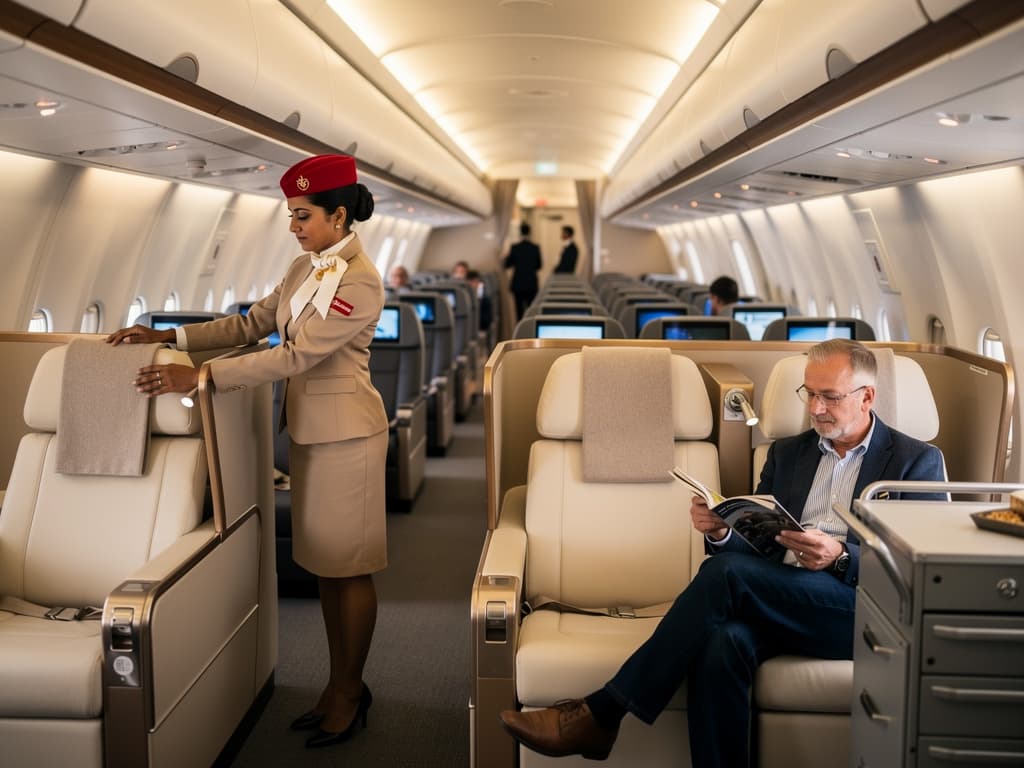
The world’s densest commercial widebody configuration is gone. Emirates confirmed that aircraft A6-EUX — the first of its 15 two-class Airbus A380 superjumbos — has completed a full cabin refit and returned to revenue service, carrying passengers between Dubai and Birmingham with a fundamentally different product than the one it replaced. The 615-seat layout, which packed 557 Economy seats across both decks, has been replaced by a three-cabin configuration that adds Premium Economy to the Upper Deck for the first time in the airline’s history.
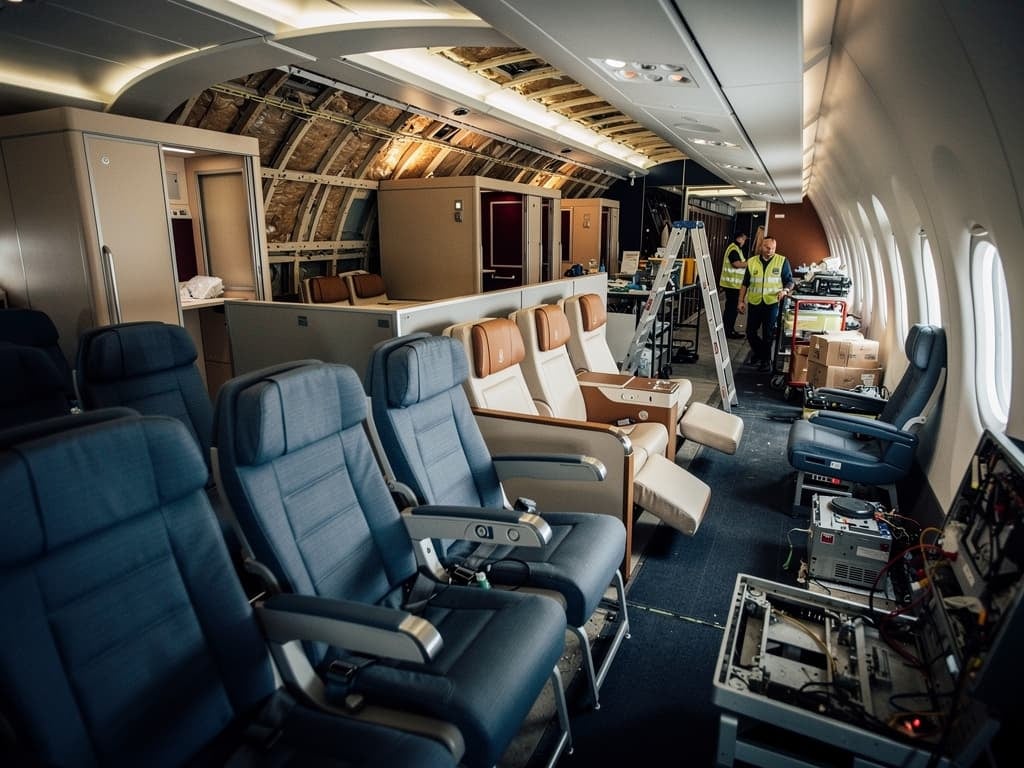
This is not a minor refresh. Fifty engineers invested roughly 35,000 man-hours over two months to complete the first aircraft, and the changes touch every cabin. Business Class expands from 58 to 76 seats. A brand-new 56-seat Premium Economy cabin occupies the forward Upper Deck in a 2-3-2 layout — narrower than the Main Deck’s 2-4-2 arrangement but more intimate. Economy shrinks to 437 seats, all on the Main Deck.
Emirates has called the milestone “defining” within a multi-billion-dollar retrofit program that has grown from an initial 120 aircraft announced in 2021 to a current scope of 219 planes spanning both A380s and Boeing 777s. The two-class A380 conversion is the most structurally significant chapter yet — and it signals where the airline believes its revenue ceiling actually sits.
The details: what changed and why it matters
The two-class A380 was always an outlier in the Emirates fleet — a high-density workhorse that sacrificed cabin diversity for sheer seat count. With 557 Economy seats and just 58 Business Class seats, it offered the least premium inventory of any Emirates widebody. The reconfigured aircraft inverts that logic entirely.
Business Class now occupies the rear of the Upper Deck with 76 seats — matching the count on Emirates’ standard three-class A380s. The new Premium Economy cabin sits forward of the U1 door on the same deck, in a 2-3-2 configuration that reflects the narrower upper-deck fuselage width. This is a meaningful distinction: every previous Emirates Premium Economy installation has been on the Main Deck in a wider 2-4-2 layout. The Upper Deck version is inherently more exclusive by geometry alone.
Industry filings confirm Emirates has committed to keeping its A380 fleet operational well into the 2030s, with the retrofit program serving as the commercial justification for that longevity. Sacrificing 120 Economy seats per aircraft is only rational if Premium Economy yield more than compensates — and Emirates’ own trajectory suggests it does.
| Cabin | Pre-retrofit seats | Post-retrofit seats | Location on aircraft | Layout |
|---|---|---|---|---|
| Business Class | 58 | 76 | Upper Deck (rear) | 2-3-2 (standard Emirates J) |
| Premium Economy | 0 | 56 | Upper Deck (forward) | 2-3-2 (new Upper Deck layout) |
| Economy | 557 | 437 | Main Deck (full) | 3-4-3 |
| Total | 615 | 569 | — | — |

Flight deals most people never see
Our AI monitors 150+ airlines for pricing anomalies that traditional search engines miss. Air Traveler Club members save $650 per trip per person on average: see how it works.
Each deal saves 40–80% vs. regular fares:

The value-add: what the Upper Deck placement actually means
Location on an A380 matters more than most booking guides acknowledge. The Upper Deck is quieter, boards faster on most jetbridges, and carries a psychological premium that Emirates is now monetizing explicitly. Placing Premium Economy there — rather than on the Main Deck alongside Economy — creates a cleaner cabin hierarchy and a more defensible price point.
The Air Traveler Club’s analysis of the Emirates A380 capacity cut notes that the retrofit voluntarily removes 46 revenue seats per aircraft, a decision that only makes commercial sense if Premium Economy yield per seat exceeds the Economy revenue it displaces. Emirates’ own rapid expansion of the program — from 120 to 219 aircraft — suggests the numbers are working.
For context: Emirates remains the only major Gulf network carrier with a Premium Economy product. Etihad Airways and Qatar Airways have not introduced a comparable mid-cabin on their long-haul fleets, leaving Emirates with a structural differentiation advantage on Europe–Dubai sectors that neither rival currently matches. That gap is about to narrow — Riyadh Air launches its debut London Heathrow service in July with Boeing 787 Dreamliners featuring Premium Economy — but Emirates’ fleet scale means the product will be far more widely available than any new entrant can match in the near term.
How to find — and book — the new Upper Deck Premium Economy
This cabin is equipment-specific, not route-wide. Knowing which flights carry the reconfigured aircraft is the difference between booking the new Upper Deck product and landing on a standard Main Deck Premium Economy layout — or no Premium Economy at all.
- Verify aircraft registration before booking: Emirates shows aircraft type on its booking flow, but configuration details require cross-referencing with seat maps at emirates.com. The Upper Deck Premium Economy will show as a distinct cabin zone forward of Business Class on the upper deck seat map.
- Dubai–Birmingham is the confirmed deployment route: A6-EUX has been operating this sector since completing its refit. Other European routes are likely candidates as the remaining 14 two-class A380s complete their 30-day refits through end of 2026.
- Inventory is tighter than the old layout: With only 56 Premium Economy seats versus 557 Economy seats on the previous configuration, availability on popular dates will compress faster. Book early on routes where the reconfigured aircraft is confirmed.
- Aircraft swaps remain a risk: Emirates operates nine different A380 configurations. A reconfigured two-class aircraft could be substituted with a standard three-class jet — or vice versa — close to departure. Check seat maps within 72 hours of travel.
- Compare against Business Class on the same dates: With Business Class expanding to 76 seats on these aircraft, award and paid inventory in the premium cabin may be more accessible than on previous two-class deployments. Run the comparison before defaulting to Premium Economy.
Watch for Emirates to announce additional route assignments for reconfigured two-class A380s as the program accelerates. If European trunk routes beyond Birmingham receive the Upper Deck Premium Economy by Q3 2026, it confirms sustained demand rather than a single-route test.
FAQ
Which Emirates routes will get the new Upper Deck Premium Economy A380?
Dubai–Birmingham is the confirmed initial deployment for A6-EUX. Emirates has not published a full route schedule for the remaining 14 two-class A380 refits, but the airline targets completion of all conversions by end of 2026. European routes are the most likely candidates given the cabin’s positioning as a premium mid-haul product.
How is the Upper Deck Premium Economy different from Emirates’ existing Main Deck Premium Economy?
The Upper Deck version uses a 2-3-2 configuration across the narrower upper-deck fuselage, compared to the 2-4-2 layout on the Main Deck. This results in fewer seats per row and a more contained cabin environment. The Upper Deck also boards separately on most jetbridges and sits physically apart from Economy, which is confined to the Main Deck on the reconfigured aircraft.
Does Emirates still operate any 615-seat two-class A380s?
As of May 2026, 14 two-class A380s remain in the fleet pending refit. These aircraft have not yet been reconfigured and may still operate in the original high-density layout. Emirates expects to complete all 14 remaining conversions within approximately 30 days each, with the full program finishing by end of 2026.
Why doesn’t Qatar Airways or Etihad offer Premium Economy?
Both carriers have historically positioned their product strategy around a strong Business Class and First Class offering, relying on those cabins to capture premium revenue. Emirates’ own late adoption — and Sir Tim Clark’s public skepticism until 2022 — reflects the same logic. Neither Etihad nor Qatar Airways has announced plans to introduce Premium Economy on their long-haul fleets as of May 2026.
Read more