Summary
American Airlines will expand premium seating across its narrow-body fleet from roughly 25% to 40% of each aircraft’s capacity, adding more first-class and extra-legroom Main Cabin Extra seats. The overhaul, announced August 18, 2026, also includes installing 4K seatback screens on more than 800 jets and introducing Starlink Wi-Fi starting in 2027, marking one of the most sweeping narrow-body cabin reconfigurations in U.S. aviation history.
The retrofit program begins in 2028 and will take until the early 2030s to complete. Newly delivered Airbus and Boeing aircraft with factory-installed screens enter service the same year, with the Boeing 737 MAX 10 configured with 24 first-class seats — a new benchmark for premium density on domestic routes.
American Airlines is betting its narrow-body fleet on premium travelers. The carrier confirmed Tuesday that it will fundamentally restructure the cabins of its domestic workhorse aircraft, lifting the share of first-class and extra-legroom seating to roughly 40% — a dramatic reversal from the densification strategy it pursued less than a decade ago.
The move directly addresses a stubborn profitability gap with Delta Air Lines and United Airlines. CEO Robert Isom has acknowledged the shortfall, and this cabin overhaul represents the most tangible evidence yet of a strategy designed to capture higher-yield revenue from travelers willing to pay for space and connectivity.
Premium passengers already punch above their weight in American’s financials. In the second quarter of 2026, they generated nearly half of ticketed revenue while occupying only about 30% of seats. The reconfiguration aims to unlock more of that revenue by creating more inventory for both paid first-class purchases and elite upgrades.
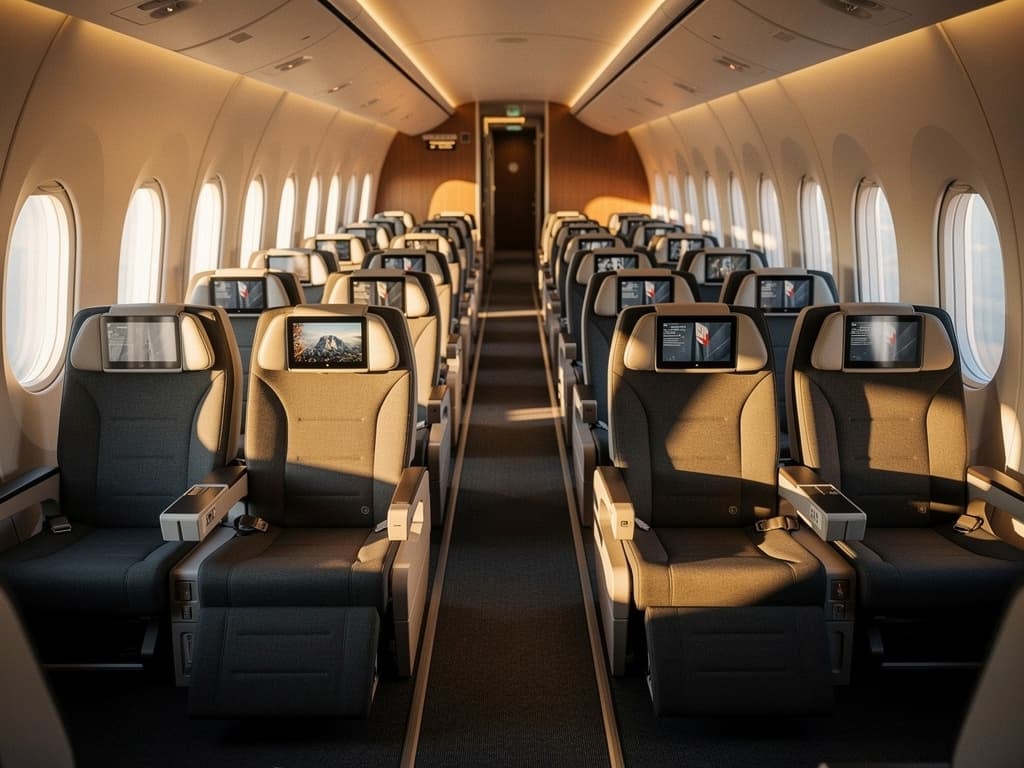
The scale is significant. More than 800 narrow-body aircraft will receive 4K seatback screens, with retrofits beginning in 2028 and continuing into the early 2030s. Starlink high-speed internet arrives even sooner — 2027 — giving American a connectivity product that matches what United is already deploying fleet-wide. The carrier declined to disclose the retrofit program’s cost.
The details
American’s retrofit plan reshapes the narrow-body fleet around premium inventory. The Airbus A319 will gain additional first-class rows, rising to 12 first-class seats. The Airbus A320 will expand to 16 first-class seats. The incoming Boeing 737 MAX 10 — a new addition to the fleet — will be configured with 24 first-class seats, the largest premium cabin American has placed on a narrow-body aircraft.
The seatback screen rollout covers both retrofitted existing aircraft and newly delivered jets. More than 140 wide-body and Airbus A321XLR aircraft already feature seatback entertainment. The narrow-body program extends that experience across the domestic fleet, pairing 4K displays with Bluetooth connectivity and Starlink’s low-latency satellite internet.
The timeline stretches across multiple years. Retrofits on existing narrow-body aircraft begin in 2028 and are scheduled for completion in the early 2030s. Newly delivered Airbus and Boeing aircraft with factory-installed screens will enter service starting the same year. Starlink installation begins earlier — 2027 — giving passengers high-speed connectivity before the full cabin refresh reaches every aircraft.
American’s detailed seat counts confirm the A319 and A320 first-class expansions, while the broader announcement outlines the 4K screen deployment and Starlink timeline.
| Aircraft type | New first-class seats | 4K screens | Timeline |
|---|---|---|---|
| Airbus A319 | 12 | Yes | Retrofit begins 2028 |
| Airbus A320 | 16 | Yes | Retrofit begins 2028 |
| Boeing 737 MAX 10 | 24 | Yes (factory-installed) | New deliveries from 2028 |
| Other narrow-body fleet | Increased (specifics TBA) | Yes | Retrofit through early 2030s |

Flight deals most people never see
Our AI monitors 150+ airlines for pricing anomalies that traditional search engines miss. Air Traveler Club members save $650 per trip per person on average: see how it works.
Each deal saves 40–80% vs. regular fares:

The value-add
This reconfiguration represents a strategic U-turn of historic proportions for American. Nearly a decade ago, Project Oasis stripped seatback screens from narrow-body aircraft and increased cabin density — a bet that passengers would use personal devices for entertainment and that squeezing in more seats would maximize revenue. Customer preferences have since reversed. Travelers now expect large seatback displays alongside personal devices, and premium revenue has proven far stickier than economy volume.
The competitive context makes the timeline urgent. United Airlines is already adding 68 Airbus A321neo and A321XLR aircraft by 2028, each with lie-flat Polaris business-class seats that double premium capacity on the routes they serve. American’s narrow-body overhaul — while focused on domestic first class rather than lie-flat — is a direct response to the premiumization trend that Delta and United have been pursuing for years. Air Traveler Club’s analysis of United’s A321neo expansion details how the premium capacity race is reshaping domestic route economics.
What the reconfiguration means for AAdvantage elites
The expansion of premium seating directly improves upgrade odds for AAdvantage elite members, though the benefit will arrive gradually as aircraft cycle through retrofit. More first-class and Main Cabin Extra inventory means more seats available for complimentary upgrades — but the effect won’t be uniform across routes or aircraft types until the program reaches scale in the 2030s.
- Upgrade inventory expands as retrofits progress. AAdvantage Platinum and Platinum Pro members receive upgrade priority over Gold members on North American routes, and the additional first-class seats on A319s, A320s, and 737 MAX 10s increase the pool of eligible seats. The 737 MAX 10’s 24-seat first-class cabin will be particularly valuable on high-demand domestic routes.
- Aircraft assignment becomes critical for upgrade strategy. Before booking, check whether your flight is operated by a reconfigured aircraft. A319s with 12 first-class seats and A320s with 16 will offer different upgrade clearance probabilities than older configurations still awaiting retrofit.
- Paid first-class inventory grows alongside upgrades. More premium seats means more opportunities to purchase first-class fares outright, which may affect upgrade availability on routes where paid demand absorbs the additional inventory.
- Main Cabin Extra expands with the premium ratio. The shift to 40% premium seating includes extra-legroom inventory, giving elites more complimentary access to preferred seating at booking.
- The timeline matters. Retrofits begin in 2028 and won’t complete until the early 2030s. Upgrade benefits will phase in over several years rather than appearing overnight.
FAQ
When will I see more first-class seats on my American Airlines flight?
The first retrofitted narrow-body aircraft enter service in 2028, with newly delivered Airbus and Boeing jets featuring factory-installed premium cabins arriving the same year. The full fleet retrofit won’t complete until the early 2030s, so availability will vary by route and aircraft type for several years. The 737 MAX 10 with 24 first-class seats will be among the most noticeable upgrades as those aircraft enter the fleet.
Will Starlink Wi-Fi be free on American Airlines?
American has not yet confirmed whether Starlink service will be complimentary or tiered. The carrier plans to begin narrow-body Starlink installation in 2027. United Airlines already offers free Starlink fleet-wide, which creates competitive pressure for American to match that pricing model, but no official announcement has been made regarding cost or speed tiers.
Does this retrofit affect American’s older Airbus A319s?
American has not confirmed whether its approximately 100 older Airbus A319s will receive the full retrofit or be retired instead. If those aircraft are phased out rather than upgraded, the premium seat expansion will apply primarily to newer and retained narrow-body aircraft. The carrier has not disclosed which subfleets are excluded from the reconfiguration program.
Read more