Summary
Cabin crew assess first-time business class passengers within 30 seconds of boarding, reading posture, boarding pass grip, dining behavior, and social media habits to identify experience level and calibrate service accordingly. From overdressing in formal business attire to ordering every course on the menu, the behavioral tells are consistent — and crew are trained to spot them. The shift toward premium cabin democratization through award redemptions and credit card bonuses has made first-timer identification a formalized part of onboarding training at carriers including Lufthansa, Singapore Airlines, and Emirates.
The good news: crew generally welcome first-timers with enthusiasm rather than judgment. Genuine courtesy and situational awareness matter far more than knowing every unspoken rule.
The curtain between economy and the premium cabin is one of aviation’s most loaded thresholds. Cross it for the first time, and you’ll find yourself in a cabin where the glassware is real, the seats fold flat, and the crew — warm as they are — are quietly reading you from the moment you step aboard.
Flight attendants working the front of the aircraft are expert behavioral analysts. Within 30 seconds of your arrival at the boarding door, they’ve already catalogued your clothing, your posture, how you’re holding your boarding pass, and whether you made eye contact. These observations aren’t judgmental — they’re functional. A first-timer often thrives on attentiveness and guidance; a corporate regular flying the route weekly wants to be left entirely alone. Crew need to know which passenger they’re dealing with before the door closes.
The behavioral tells are remarkably consistent across carriers and routes. Overdressing in a tailored suit signals unfamiliarity with the physical reality of sleeping at altitude. Staring at a touchscreen trying to locate the lumbar support reveals a passenger encountering the seat’s engineering for the first time. Ordering every course on the menu — and ringing the call button for champagne refills every 15 minutes — reflects a scarcity mindset that seasoned travelers simply don’t carry into the cabin. And pulling out a smartphone to photograph the amenity kit before the door has even closed? That one’s unmistakable.
None of these behaviors are wrong. But understanding them — and what they signal — gives first-time premium flyers a meaningful advantage in navigating the front of the aircraft with confidence.
What crew actually see when you board
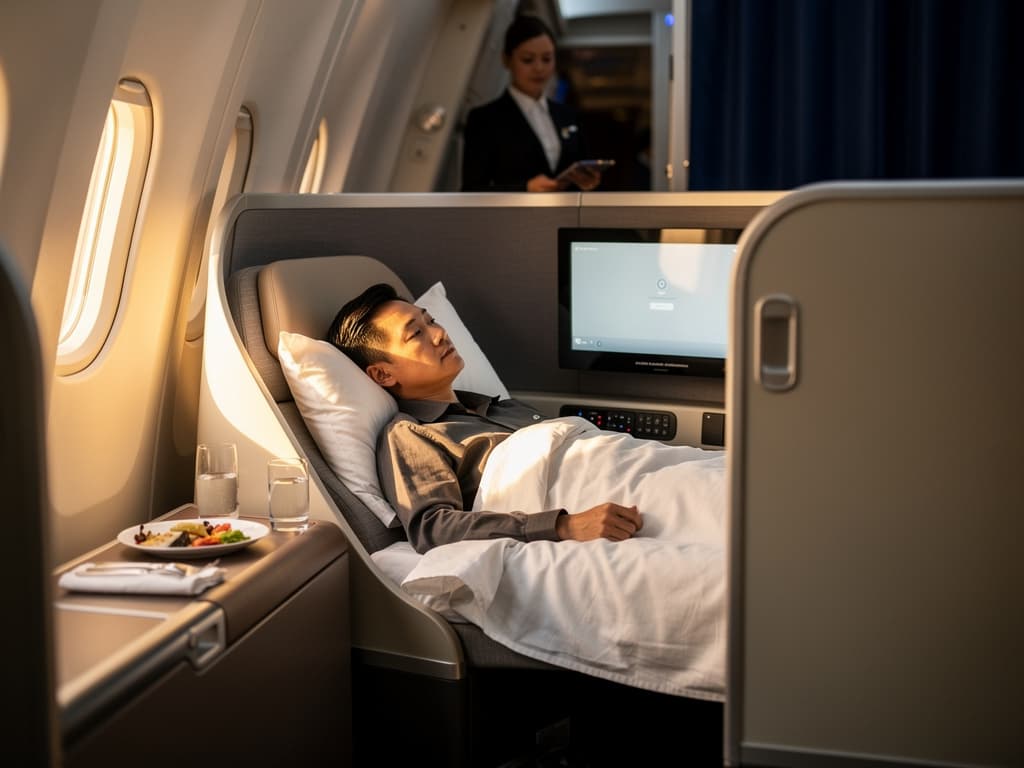
The boarding door assessment begins with clothing. Veteran business class travelers have converged on a functional uniform: breathable layers, slip-on shoes, garments that survive a few hours of sleep without looking destroyed. Showing up in stiff dress shoes and a tailored jacket communicates that you haven’t yet learned the grueling physical reality of long-haul premium travel — that the seat is a bed, not a conference room.
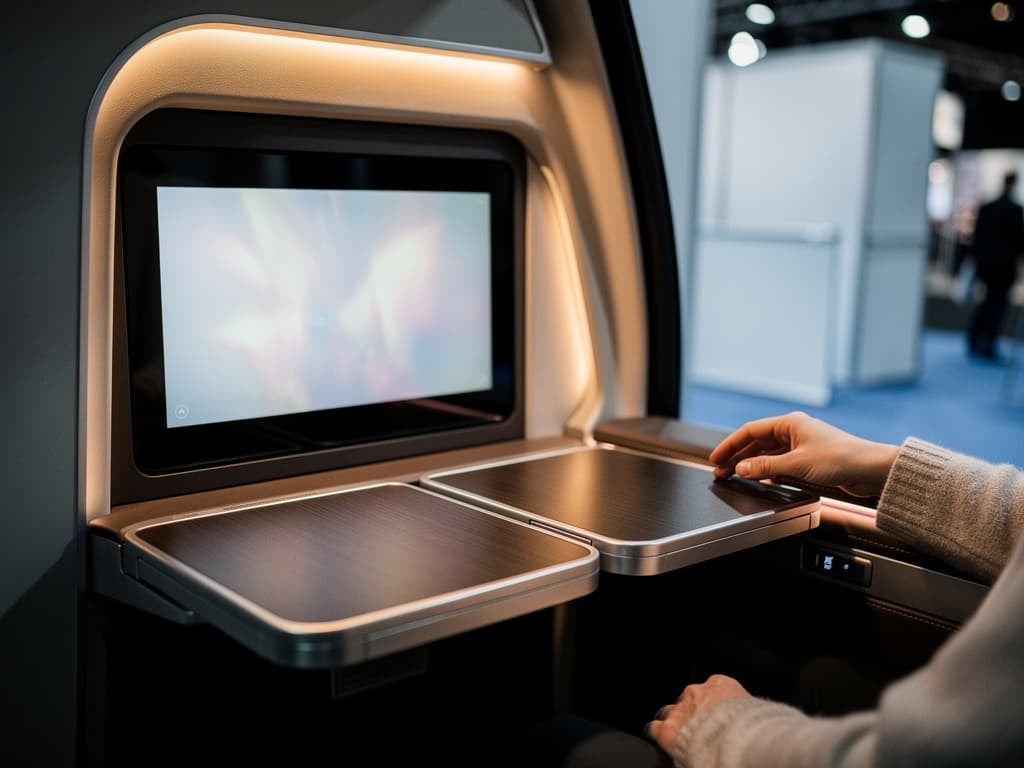
Seat operation is the second major tell. Modern business class suites feature multiple recline positions, integrated massage settings, privacy doors, and tray tables hidden beneath the seat or inside a side console rather than attached to the seatback in front. First-timers frequently require crew assistance to locate basic components. A seasoned traveler deploys the table and moves to 180° recline without a second thought.
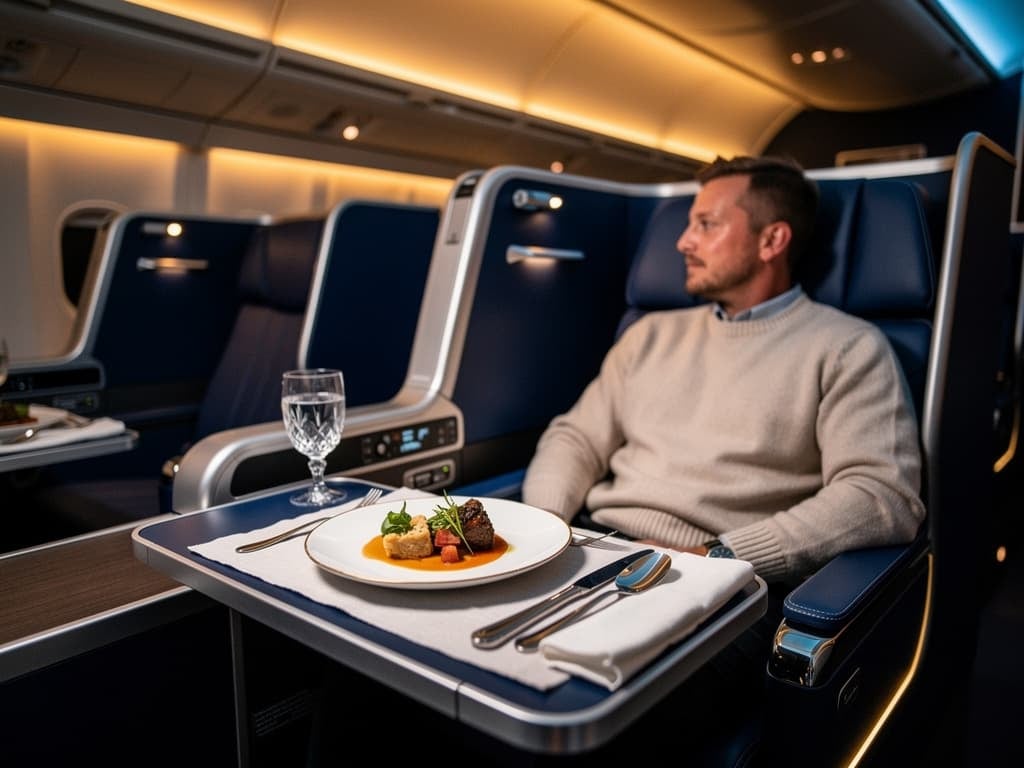
Dining behavior is where the psychological divide becomes most visible. Passengers new to premium cabins often operate from scarcity mindset — ordering appetizers, entrées, cheese courses, and dessert even when not particularly hungry, because the ticket price feels like it demands full extraction of value. Frequent flyers often skip the meal service entirely, prioritizing sleep over a mid-flight steak. They’re not worried about missing out because the flight is a routine part of their week.
Social media documentation rounds out the primary tells. For the business traveler, the suite is an office or a bedroom — photographing it would be as mundane as photographing their desk at home. For the first-timer, the cabin is a destination in itself, and the smartphone comes out immediately to capture the lie-flat configuration, the designer amenity kit, and the pre-departure champagne.
| Behavior | First-timer signal | Veteran equivalent | Crew response |
|---|---|---|---|
| Formal business attire at boarding | Unfamiliarity with sleep-focused travel | Breathable layers, slip-on shoes | Proactive comfort guidance offered |
| Difficulty operating seat controls | First encounter with suite engineering | Immediate recline, no assistance needed | Seat orientation walkthrough initiated |
| Ordering every menu course | Scarcity mindset, value extraction | Light meal or skip entirely for sleep | Pacing guidance, gentle course management |
| Frequent call button use for drinks | Novelty of unlimited service | Measured consumption, minimal requests | Noted; service rhythm adjusted |
| Smartphone photography of suite | Milestone experience framing | No documentation; functional use only | Anticipate more guidance needs on features |
| Over-apologizing for service requests | Viewing cabin as luxury, not routine | Confident, direct requests | Reassurance offered; extra attentiveness |
| Watching crew service process intently | Savoring a rare experience | Laptop open or asleep before gear up | Often cited as crew’s favorite passenger type |

Flight deals most people never see
Our AI monitors 150+ airlines for pricing anomalies that traditional search engines miss. Air Traveler Club members save $650 per trip per person on average: see how it works.
Each deal saves 40–80% vs. regular fares:

Why crew actually prefer first-timers
Here’s the counterintuitive reality: flight attendants who have spent years serving indifferent corporate regulars often find first-timers to be the most rewarding passengers in the cabin. The genuine delight — the grin when champagne is topped off, the real wonder at a lie-flat bed — is something that frequent flyers stopped experiencing long ago.
First-timers are also, almost universally, the passengers who acknowledge crew as fellow human beings rather than service infrastructure. That basic courtesy has tangible consequences. Crew members are demonstrably more likely to offer an extra amenity kit, a better meal option, or a proactive seat adjustment to a passenger who shows genuine warmth and gratitude.
The behavioral evolution of premium cabin passengers reflects a broader industry shift. Business class access has expanded through three channels — paid fares (typically $5,000–$12,000 roundtrip on transatlantic routes), elite status upgrades, and award redemptions ranging from 60,000 to 100,000 miles one-way — creating a cabin that now mixes corporate regulars with first-time award redeemers and occasional splurgers. Air Traveler Club’s mixed-cabin booking framework details how first-timers can access lie-flat seats on long-haul segments at significantly reduced award costs, a strategy that’s increasingly relevant as premium cabin democratization accelerates.
Carriers including Lufthansa, Singapore Airlines, and Emirates have formalized crew training to identify and accommodate first-time passengers without making them feel self-conscious — a competitive differentiator that separates premium service leaders from commodity operators. The forward signal for 2026–2027: expect AI-assisted passenger profiling at check-in to flag first-timers for proactive crew briefing, shifting the industry from reactive observation to anticipatory service design.
Timing your first business class booking for maximum value
Understanding crew behavioral cues is only half the equation — getting into the cabin at the right price is the other. Paid business class fares follow predictable seasonal patterns, and award space has its own distinct logic that rewards advance planning.
- Paid fare timing: Book 60–90 days in advance for off-peak travel (September–October, January–February), when transatlantic business fares dip to $4,500–$6,500 roundtrip — roughly 30–40% below peak June–August pricing of $8,000–$12,000.
- Award redemptions: Search 11 months before departure for premium routes (London, Tokyo, Paris); secondary markets open up at 6–8 months. Award space tightens sharply in the final 2–3 weeks before departure.
- Search tools: Use airline websites directly (united.com, delta.com, aa.com) or ExpertFlyer to identify award inventory before committing miles. ExpertFlyer’s seat map view also reveals cabin load — useful for upgrade bid strategies on carriers like Royal Brunei.
- Credit card alignment: Time sign-up bonus applications to align with 3–6 month minimum spend windows, enabling business class redemptions within 4–5 months of card approval.
- Route constraints: Business class inventory on premium routes — London, Tokyo, Sydney — remains consistently constrained. First-time bookers should treat these as requiring advance planning equivalent to a sold-out concert, not a last-minute hotel booking.
Watch for airline announcements in late 2026 regarding formalized first-timer recognition training. If major carriers codify this as a competitive differentiator, it signals that premium cabin service is bifurcating into segmented approaches based on passenger experience level — a development that would meaningfully change the onboarding experience for first-time premium flyers.
FAQ
Do cabin crew treat first-time business class passengers differently from frequent flyers?
Yes — deliberately. Crew are trained to identify experience level within the first 30 seconds of boarding and calibrate service intensity accordingly. First-timers typically receive more proactive guidance on seat operation, dining pacing, and amenity kit use. Frequent flyers are often left to their established routines with minimal interruption. The goal is personalization without patronization.
Is it considered bad etiquette to photograph the business class cabin?
Not inherently, but discretion matters. Crew recognize smartphone documentation as a first-timer tell, but they don’t object to it. The unspoken rule is to avoid photographing neighboring passengers or disrupting the cabin atmosphere with flash or extended filming. Capturing the suite, amenity kit, and meal presentation is entirely normal — just stay aware of the shared environment.
Which airlines are most accommodating for first-time business class passengers?
Singapore Airlines and Lufthansa are consistently noted for proactive passenger guidance and crew attentiveness toward inexperienced premium travelers. Emirates offers structured onboarding through its premium bar service and suite orientation. United Airlines and American Airlines crews tend toward efficiency over personalization, though individual crew quality varies significantly by route and flight.
What’s the most common mistake first-time business class passengers make?
Seat operation confusion is the most universal tell — specifically, failing to locate the tray table (often hidden beneath the seat or inside a side console) and not knowing how to move between recline positions. Reviewing the specific seat product via airline YouTube tutorials or SeatGuru before boarding eliminates this entirely and immediately signals familiarity to crew.
Read more