Summary
United Airlines CEO Scott Kirby has pitched a merger with American Airlines to senior government officials, a move that would create a carrier with over $100 billion in annual revenue and 2,800+ aircraft — eclipsing Delta Air Lines to dominate domestic and Latin American premium routes. American shares jumped 4.7% in premarket trading April 14, 2026, while United rose 2.8%, though no formal merger process has begun.
The proposal faces steep antitrust hurdles despite Transportation Secretary Sean Duffy’s openness to consolidation. Kirby’s personal history — he left American in 2016 after being denied a path to CEO — adds a dramatic subplot to what would be the industry’s most consequential deal since the 2013 American–US Airways merger.
The audacious pitch surfaced through industry sources on April 13, 2026, revealing Kirby’s conversations with government officials about combining the nation’s two largest legacy carriers. A merged entity would control roughly 35% of domestic capacity and dominate premium transcontinental and Latin America routes where both airlines deploy lie-flat business class products.
Kirby’s departure from American Airlines eight years ago — when it became clear he wouldn’t succeed Doug Parker as CEO — makes this proposal deeply personal.
He joined United as president in 2016 and ascended to CEO in 2020, transforming the carrier’s premium strategy with aggressive Polaris business class expansion and international route additions.
The merger would affect MileagePlus and AAdvantage elite members holding status in both programs, business and first class travelers on overlapping hub routes through Chicago O’Hare, Los Angeles, and New York, and anyone booking premium award space to Latin America — where the combined carrier would hold near-monopoly positioning on key routes to Mexico City, São Paulo, and Buenos Aires.
The regulatory and competitive landscape
Transportation Secretary Sean Duffy indicated on April 7, 2026, that the administration sees “room for mergers” in U.S. aviation, though he emphasized any deal must prove it won’t increase costs for travelers. The Department of Justice would conduct antitrust review alongside DOT scrutiny, with likely requirements for slot divestitures at overlapping hubs. Industry analysis suggests approval odds below 20% within 12 months given the combined carrier’s market dominance.
The merger would create an airline with over 2,800 aircraft and $100 billion in annual revenue, dwarfing Delta‘s current 20% domestic market share. Historical precedent from the 2010 United–Continental merger shows business class fares rose 7% on hub routes in year two, while the 2008 Delta–Northwest combination saw premium transcontinental fares climb 12% post-integration. Elite status holders in both mergers received temporary matching for top tiers, with no immediate requalification resets.
The combined carrier would directly compete against Delta One suites on transcontinental routes and international long-haul, while Southwest Airlines — offering no premium cabins — would remain a low-fare alternative. JetBlue‘s Mint business class competes primarily on East Coast routes at $800+ one-way, positioning it as a niche player. United currently operates over 15,000 Polaris seats annually, while American leads DFW-Latin America Flagship service with extensive regional connectivity.
| Airline | Seat product | Key specs | Approximate pricing |
|---|---|---|---|
| United Airlines | Polaris business | Lie-flat, direct aisle access, 6’6″ bed | $3,200-4,800 RT transcon |
| American Airlines | Flagship Business | Lie-flat reverse herringbone, 6’8″ bed | $2,900-4,500 RT transcon |
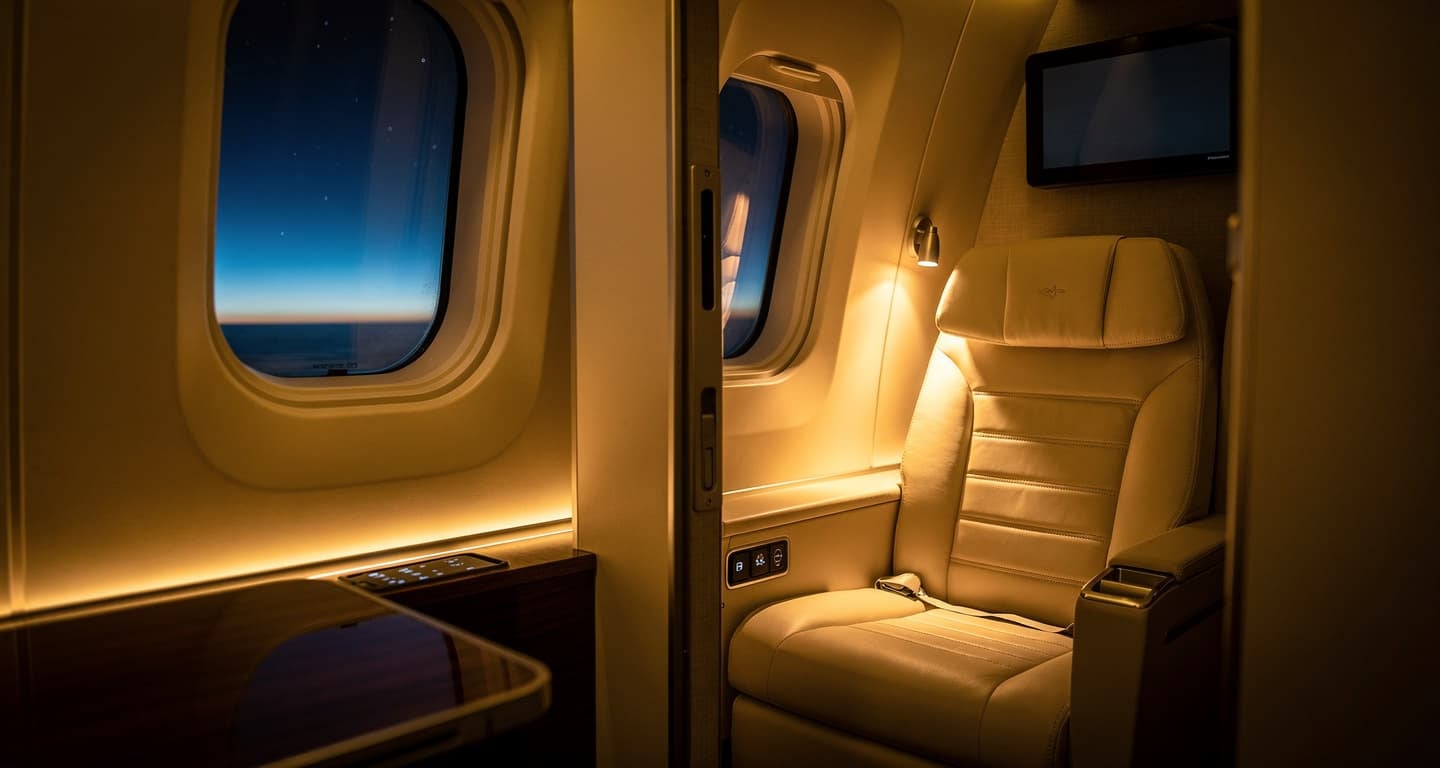
| Delta Air Lines | Delta One Suites | Lie-flat with sliding door, 6’7″ bed | $3,500-5,200 RT transcon |
| JetBlue Airways | Mint business | Lie-flat, select routes only | $800-1,600 one-way East Coast |

Flight deals most people never see
Our AI monitors 150+ airlines for pricing anomalies that traditional search engines miss. Air Traveler Club members save $650 per trip per person on average: see how it works.
Each deal saves 40–80% vs. regular fares:

What this means for premium travelers
The merger would fundamentally reshape premium cabin availability and pricing across domestic and Latin American routes. United‘s premium revenue accounts for 25% of total revenue, exceeding American‘s 20% share, suggesting the combined entity would prioritize Polaris product standards over Flagship configurations. Kirby has previously criticized American‘s slower premium cabin rollout, indicating potential fleet harmonization toward United‘s specifications.
Award space dynamics would shift significantly. The combined MileagePlus and AAdvantage programs would control the largest premium award inventory to Latin America, potentially tightening availability on peak routes while offering broader redemption options through merged partnerships. Historical integration timelines suggest 18 months for full loyalty program merger, with temporary elite status matching for top tiers during transition.
Air Traveler Club’s analysis of DOT merger signals suggests the administration’s April 7 openness to consolidation creates a narrow approval window, though any deal would require case-by-case asset divestitures to preserve competition — likely targeting Chicago O’Hare and Los Angeles International slots where both carriers maintain fortress hubs.
Strategic guidance for premium travelers
The merger pitch creates immediate booking urgency for anyone holding elite status or planning premium travel on overlapping routes within the next 12-18 months.
- Secure award bookings immediately — Lock in Polaris and Flagship award space now at current redemption rates before potential devaluation; use ExpertFlyer.com for inventory alerts on Latin America routes where combined carrier would dominate
- Diversify elite status strategy — Consider pursuing Delta SkyMiles Medallion status or Alaska Airlines MVP Gold as hedge against potential MileagePlus/AAdvantage integration disruptions and benefit reductions
- Monitor hub route pricing — Track business class fares on Chicago-Los Angeles, New York-Dallas, and Los Angeles-Miami routes where capacity cuts would likely drive 10-15% price increases within 6-12 months of approval
- Query status protection options — Contact airline elite desks within 48 hours to document current benefits and establish paper trail for potential matching claims during integration
- Prepay lounge access strategically — Annual United Club and Admirals Club memberships purchased now would likely transfer post-merger, locking current pricing before potential fee increases
Watch for DOJ antitrust filing within 30 days — approval with divestitures signals viable path forward, while rejection preserves current competitive dynamics and award availability.
FAQ
Would my elite status transfer automatically in a United-American merger?
Historical precedent from the 2010 United-Continental merger shows top-tier elites (Premier 1K and Continental Elite) received automatic status matching during the 18-month integration period, with no requalification resets in year one. Lower tiers typically required challenge applications through airline portals.
How quickly could this merger actually happen?
Even with Trump administration openness to consolidation, DOJ antitrust review typically requires 12-18 months, with additional 6-12 months for operational integration. The earliest realistic timeline for loyalty program changes would be Q2 2027, assuming regulatory approval by late 2026.
What happens to my existing award bookings if the merger goes through?
Existing confirmed award tickets would be honored at booked redemption rates regardless of merger status, based on DOT consumer protection rules. Unconfirmed waitlisted awards might face cancellation during system integration, making immediate confirmation critical for travel beyond 12 months out.
Could this merger actually get approved given the market concentration?
The combined carrier would control 35%+ domestic capacity, exceeding thresholds that triggered DOJ challenges in past merger attempts. Approval would likely require significant slot divestitures at Chicago O’Hare, Los Angeles, Dallas-Fort Worth, and New York airports — potentially making the deal economically unviable for United.
Read more