Summary
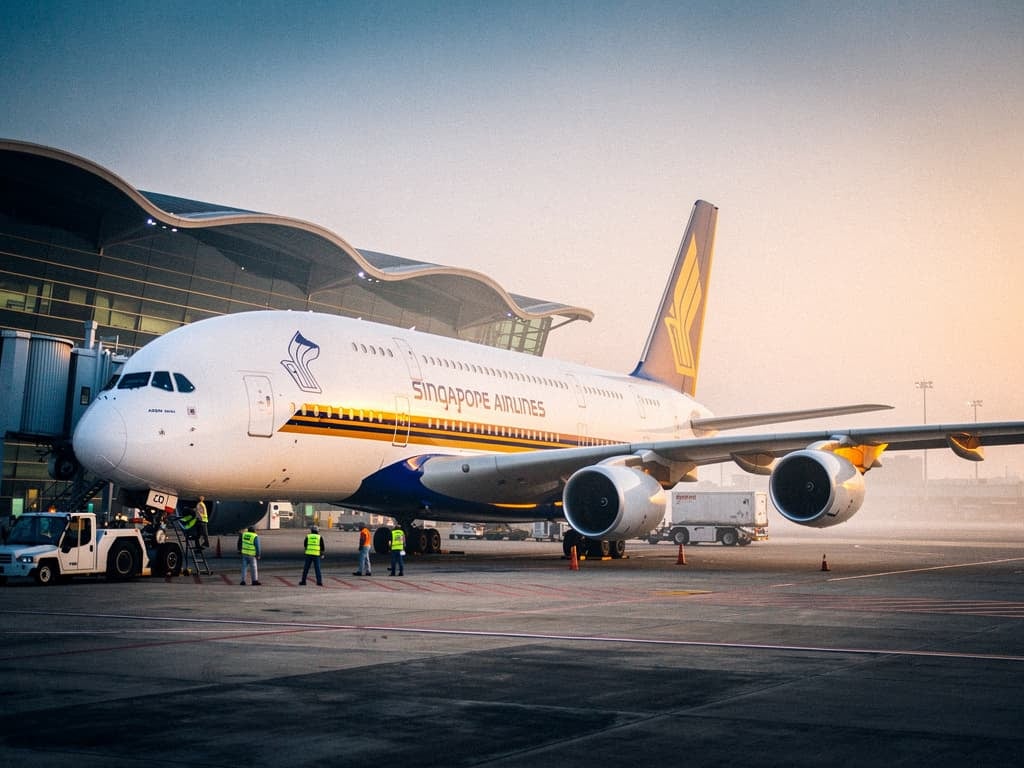
Singapore Airlines Group posted record full-year revenue of S$20.52 billion for FY2025/26, with operating profit climbing sharply on the back of lower fuel costs, disciplined hedging, and demand that outpaced capacity expansion — pushing the group’s passenger load factor to 87.7%. Net profit fell 57.4% to S$1.18 billion, but the decline is an accounting artifact: the prior year included a one-off S$1.1 billion gain from the Vistara-Air India merger, while this year’s accounts absorb proportional losses from SIA’s 25.1% stake in Air India.
Core operations at both Singapore Airlines and Scoot remain structurally sound, with premium cabin yields rising in Q3. The airline’s own fuel cost warning signals that FY2026/27 fare stability is not guaranteed.
Strip away the India accounting noise and Singapore Airlines Group’s FY2025/26 results tell a straightforward story: the world’s most consistently decorated airline is flying more people, filling more seats, and generating more revenue than at any point in its history. Record full-year revenue of S$20.52 billion — up 5% year-on-year — arrived alongside a sharp improvement in operating profit, driven by fuel cost reductions and hedging gains that management itself warns may not repeat.
The headline net profit figure of S$1.18 billion will dominate coverage, but it obscures more than it reveals. Last year’s S$2.78 billion net profit was inflated by a non-recurring S$1.1 billion gain from folding Vistara into Air India. This year, SIA’s 25.1% stake in Air India means proportional losses flow directly onto the group’s books — a structural drag that will persist until Air India’s own turnaround takes hold.
What matters for the airline’s operational trajectory is the passenger business. Singapore Airlines and Scoot together achieved a load factor of 87.7% for the full year, with demand consistently outrunning capacity additions. In Q3 FY2025/26 alone — the quarter ending December 31, 2025 — the group carried 10.9 million passengers, up 6.3% year-on-year, on record quarterly revenue of S$5.506 billion. By December 2025, SIA had surpassed its own January 2020 pre-pandemic capacity and passenger benchmarks.
The expansion agenda is accelerating in parallel. New routes to Madrid via Barcelona and Western Sydney International Airport are confirmed, alongside frequency increases to London-Gatwick, Manchester, Milan, Munich, and Melbourne. A S$1.1 billion cabin retrofit program is underway, with Starlink broadband connectivity scheduled for Airbus A350 and A380 fleets from 2027.
The numbers behind the record
The group’s official full-year results release confirms that operating cost reductions of 1.8% were the primary lever behind the operating profit improvement — a meaningful achievement given the inflationary environment that has pressured airline cost bases globally. Fuel costs fell and hedging positions paid off. The group’s own forward guidance, however, flags that sustained oil price increases in the current environment represent a material risk to FY2026/27 results.
Cargo revenue dipped 2.1% to S$2.1 billion, attributable to yield compression even as cargo volumes expanded — a pattern consistent with broader air freight market normalization after the post-pandemic surge. The Middle East suspension of services to Dubai and Jeddah, driven by geopolitical instability, created a capacity gap on high-yield routes that the European and Australian expansion is partly designed to offset.
| Metric | FY2025/26 result | Year-on-year change | Context |
|---|---|---|---|
| Full-year revenue | S$20.52 billion | +5% | All-time group record |
| Net profit | S$1.18 billion | −57.4% | Prior year inflated by S$1.1B Vistara gain |
| Q3 operating profit | S$792 million | +25.9% | Record quarterly revenue of S$5.506B |
| Passenger load factor | 87.7% | +1.1 percentage points | Demand outpacing capacity expansion |
| Q3 passengers carried | 10.9 million | +6.3% | SIA + Scoot combined |
| Cargo revenue | S$2.1 billion | −2.1% | Yield compression despite volume growth |
| Air India stake | 25.1% | N/A | Proportional losses consolidated into group accounts |

Flight deals most people never see
Our AI monitors 150+ airlines for pricing anomalies that traditional search engines miss. Air Traveler Club members save $650 per trip per person on average: see how it works.
Each deal saves 40–80% vs. regular fares:

What record loads mean for premium cabin access
An 87.7% system-wide load factor is not an abstract financial metric — it is a direct signal of how competitive award space and upgrade availability will be on Singapore Airlines‘ most sought-after routes. Business Class yields rose in Q3 FY2025/26 amid sustained demand, and the airline’s capacity expansion into Europe and Australia is designed to meet that demand rather than relieve pricing pressure.
For KrisFlyer members, the practical implication is tighter inventory on peak routes. The SIN-LHR corridor — where SIA competes directly with Emirates A380 First and Qatar Airways Qsuite — already sees Business Class awards averaging 90,000–120,000 miles one-way under dynamic pricing, with Suites requiring either top-tier elite status or cash upgrades. The Malaysia Airlines-Singapore Airlines joint business partnership, which Air Traveler Club’s analysis of the partnership’s KrisFlyer and Enrich cross-earn implications covers in detail, adds a further dimension: as coordination deepens, KrisFlyer elites gain additional earning pathways that partially offset tighter SIA-metal award availability.
The competitive picture on SIN-LHR remains nuanced. Emirates First offers shower spas at approximately S$12,000 round-trip versus SIA Business at roughly S$8,500 — a meaningful price gap that SIA’s service consistency and SilverKris lounge network helps justify. The incoming Starlink connectivity from 2027 and the cabin retrofit program will further differentiate the product at a moment when Qatar Airways Qsuite remains the privacy benchmark and Cathay Pacific‘s Business Class holds an edge in dining.
How to position KrisFlyer bookings against SIA’s fuel warning
SIA’s record revenue confirms the airline is investing in its product, not retreating from it — but the fuel cost warning embedded in the FY2025/26 report is a specific, time-bounded signal that current fare and award rate conditions may not persist into FY2026/27. For frequent flyers with SIN-Europe or SIN-Australia itineraries in the planning horizon, the strategic calculus is clear.
- Book Business Class awards now at current dynamic rates: KrisFlyer Business Class awards on SIN-Europe are currently pricing at 90,000–120,000 miles one-way. If fuel surcharges materialize as the airline’s own guidance implies, cash fares will rise first — compressing the value gap between cash and award bookings.
- Use the 355-day booking window: KrisFlyer members can search and hold award space up to 355 days out on singaporeair.com. SIN-LHR and SIN-SYD Business Class inventory tightens significantly inside 90 days given the 87.7% load factor environment.
- Check Star Alliance partners for SIN-Europe space: United MileagePlus and other Star Alliance programs can access Singapore Airlines award inventory, sometimes with better availability windows than booking direct through KrisFlyer — particularly on routes where SIA is the operating carrier but not the ticketing partner.
- Monitor the Q4 2026 retrofit deployment: If the first retrofitted A350 enters service on SIN-Europe routes before year-end 2026, award redemptions on those specific flights will deliver materially upgraded cabin hardware — making the timing of redemption as important as the points cost.
- Watch for Middle East route reinstatement: Suspended services to Dubai and Jeddah represent high-yield capacity currently offline. Reinstatement would add award inventory on those corridors and potentially relieve pressure on SIA’s European routing alternatives.
FAQ
Why did Singapore Airlines’ net profit fall so sharply if revenue hit a record?
The FY2025/26 net profit of S$1.18 billion compares against a prior-year figure that included a non-recurring S$1.1 billion gain from the integration of Vistara into Air India. Remove that one-off item and the year-on-year decline is far less dramatic. Additionally, SIA’s 25.1% stake in Air India means the group now consolidates a proportional share of Air India’s losses directly into its accounts — an ongoing drag that will persist until Air India reaches profitability.
Will KrisFlyer award rates or Business Class surcharges change as a result of these results?
No KrisFlyer award rate changes or new premium surcharges have been announced following the FY2025/26 results. Business Class dynamic pricing currently sits at 90,000–120,000 miles one-way for SIN-Europe. The risk to this stability is fuel costs: SIA’s own results report flags that sustained oil price increases could affect FY2026/27 pricing, making current rates a relative window of value for forward bookings.
Which routes are affected by Singapore Airlines’ Middle East suspension?
Singapore Airlines has suspended services to Dubai (DXB) and Jeddah (JED) due to geopolitical instability in the region. These are high-yield routes, and their suspension has contributed to the airline redirecting capacity toward European and Australian expansion — including new services to Madrid via Barcelona and Western Sydney International Airport, plus increased frequencies to London-Gatwick, Manchester, Milan, Munich, and Melbourne.
When will the Singapore Airlines cabin retrofit and Starlink Wi-Fi be available?
The S$1.1 billion cabin retrofit program is underway, with the first retrofitted Airbus A350 expected in Q4 2026. Starlink broadband connectivity is scheduled to begin rolling out on A350 and A380 long-haul aircraft from Q1 2027, with full fleet deployment completing by end of 2029. Complimentary unlimited access will continue for Suites, First, Business Class, and PPS Club members.
Read more