Summary
Business class suites are no longer built to showcase luxury—they exist to rescue airline balance sheets. Delta Air Lines’ premium cabin revenue surged to $5.4 billion in Q1 2026, landing just $41 million short of matching all main-cabin sales, while American Airlines credits its AAdvantage loyalty program with driving 77% of premium bookings. The five largest US carriers pulled in $28 billion from loyalty and credit-card partnerships in a single year, turning the front of the aircraft into a financial flywheel that far outscores ticket revenue.
The same calculus is accelerating the unbundling of business-class perks. By the end of 2026, Delta will finalize tiered fare structures that could charge extra for lounge access and seat selection even in a lie-flat suite, forcing award travelers on trans-Pacific routes to rethink how they book and what they’ll actually get.
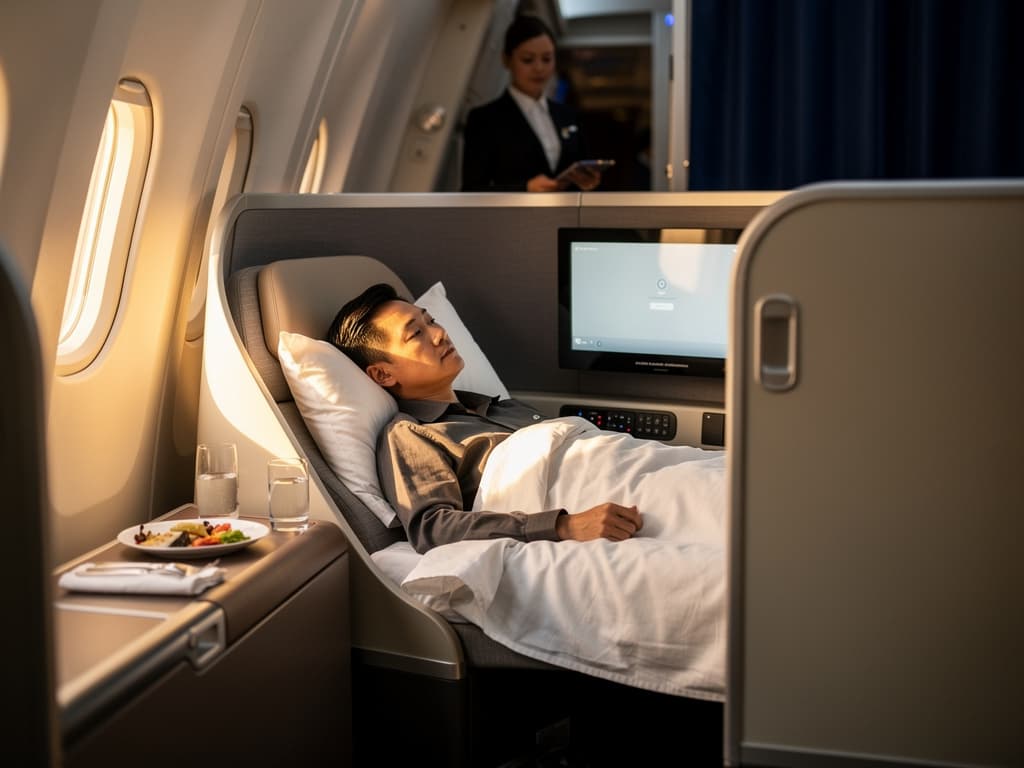
Walk through any new widebody delivery today and the geometry of profit is unmistakable. Delta Air Lines now configures roughly 50% of floor space on fresh long-haul aircraft as premium seating, up from 30% on older jets. The back of the cabin is shrinking by design, cordoned off from commodity fare wars so every square inch inflates return on capital.
The numbers vindicate the gamble. During the first quarter of 2026, Delta’s premium ticket revenue jumped 14% year-on-year to $5.4 billion, landing within striking distance of the main cabin’s entire haul. When cargo, maintenance, and loyalty-ecosystem income are folded in, non-economy streams now account for 62% of total enterprise revenue.
That loyalty math is what transforms a lie-flat cocoon into a balance-sheet asset. American Airlines reports that its AAdvantage program—whose standalone valuation routinely eclipses the airline’s own market cap—drives 77% of its premium-cabin bookings. The five largest US carriers collectively harvested $28 billion in a recent year from loyalty and co-branded credit-card partnerships, a sum that operates at enormous margins. Delta’s American Express remuneration alone topped $2 billion in Q1 2026, a 10% jump from the prior year. Without those aspirational redemptions anchoring card-spend, the most profitable corner of the airline portfolio would crumble.
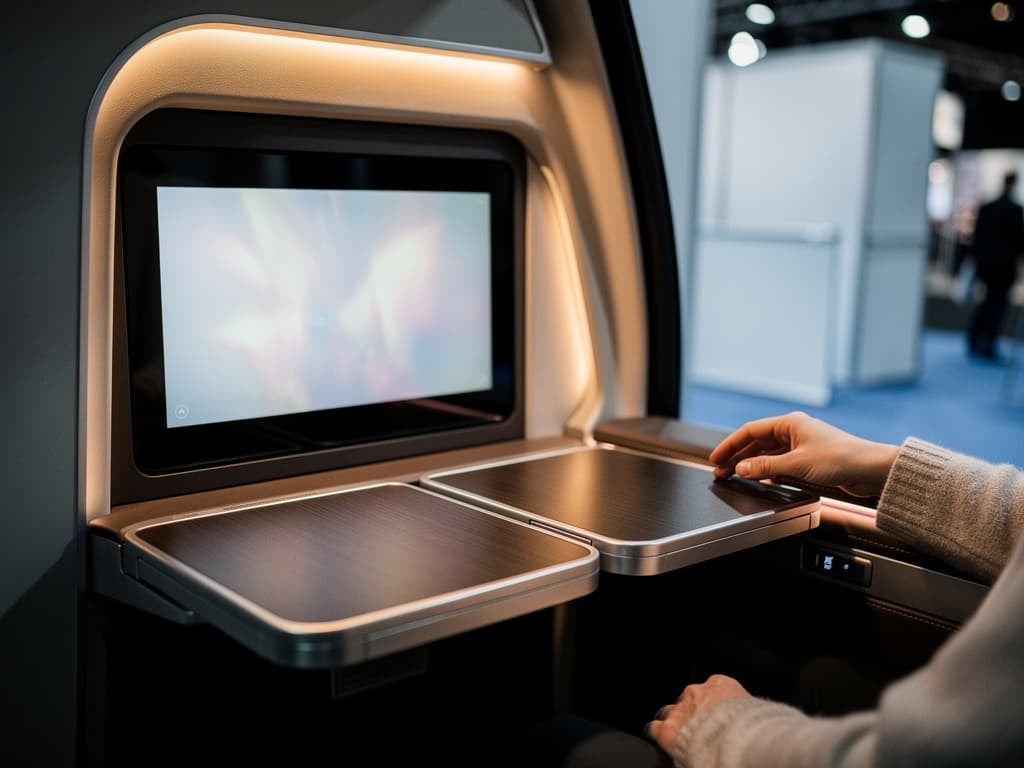
Asia-Pacific carriers set the physical blueprint. All Nippon Airways’ The Room business class uses alternating forward- and rear-facing seats to deliver a 36-inch cushion width while compressing pitch; Japan Airlines’ Airbus A350-1000 suites employ ultra-thin sliding doors and headrest speakers to maximize premium density without a weight penalty. Every millimeter is a line item.
Meanwhile, United Airlines has already introduced tiered basic-business fares, and Delta intends to finalize its own unbundled structure by the end of 2026, potentially making seat selection and lounge entry paid add-ons—even for a flatbed ticket. That splits the front-of-plane into configurable revenue layers, insulating the carrier from the economy cabin’s volatility while locking in high-yield passengers who almost never go back. Delta’s own data shows premium-cabin retention hovers in the mid-80% range, a behavioral ratchet that justifies the steep retrofit expense.
The dollars behind the design
Strip away the Missoni duvets and marble-clad lounges, and what’s left is a carefully engineered ledger of revenue density, partner remuneration, and customer-acquisition cost. The numbers below show how three key players stack that ledger.
| Metric | Airline/Entity | Figure | Context |
|---|---|---|---|
| Premium revenue, Q1 2026 | Delta Air Lines | $5.4 billion | Within $41M of main cabin; 14% YoY growth |
| Premium bookings driven by loyalty program | American Airlines | 77% | AAdvantage loyalty members fuel premium load |
| Big-five US airline loyalty & credit-card income | Industry aggregate | $28 billion (recent year) | Independent valuations exceed airline market caps |
| Delta Amex remuneration, Q1 2026 | Delta Air Lines / American Express | $2+ billion | 10% YoY rise; anchors card spend to premium redemptions |

Flight deals most people never see
Our AI monitors 150+ airlines for pricing anomalies that traditional search engines miss. Air Traveler Club members save $650 per trip per person on average: see how it works.
Each deal saves 40–80% vs. regular fares:

What the accounting shift means for award redemptions
The unbundling wave changes how points accumulate and spend. Air Traveler Club’s deep dive into award-booking strategies on these new cabins shows that savvy travelers can still extract outsize value—if they act before tiered fare structures go live. Because seats like The Room and JAL’s A350-1000 suite are engineered for density, partner programs such as United MileagePlus and American AAdvantage often release space at competitive rates, especially when cash prices are elevated by the new “basic business” tiers.
That dynamic rewards those who book early and understand which loyalty currencies retain lounge and seat privileges versus those that don’t. It also underscores why the unbundling trend is accelerating: as IATA projects an industry operating margin of just 3.9% for 2026, every lounge swipe and premium seat assignment becomes a revenue-generating opportunity that was previously cost.
Positioning your points before the unbundling hits
As airlines turn the premium cabin into a segmented financial instrument, your booking strategy must mirror the shift. Points and status are about to buy less if you don’t act deliberately, especially on trans-Pacific routes where Asian carriers offer aspirational suites while US legacies unbundle.
- Lock in partner awards now. Book The Room or JAL’s A350‑1000 suites via MileagePlus or AAdvantage while inclusive perks remain standard—redemption rates currently hover around 70,000–90,000 points one-way, and that value could erode once cash surcharges spread to award bookings.
- Monitor the 48-hour seat-release window. Carriers block row one for elites but algorithmically release those seats to any business-class passenger two days before departure. Use it to grab a premium seat without paying an unbundled fee.
- Stack elite-qualifying spend on co‑branded cards. With loyalty programs generating the bulk of premium bookings, maintaining top-tier status is the only guarantee that seat selection and lounge access won’t become separate charges—even after tiered fares arrive.
- Watch Delta’s end‑2026 deadline. If the carrier finalizes its unbundled premium fare structure as planned, expect lounge access and advanced seat assignments to become optional add-ons for business-class tickets, fundamentally changing the cost calculation for award redemptions on SkyTeam partners.
- Diversify transferable points away from purely revenue-based redemption models. Amex, Chase, and Citi ThankYou points that flow into ANA Mileage Club or JAL Mileage Bank can still secure a fully‑featured suite without the layered fees that US programs will soon introduce.
FAQ
Will I have to pay extra for seat selection or lounge access if I book business class with miles?
After Delta launches tiered premium fares by end‑2026, yes. The lowest-tier business-class reward is expected to exclude complimentary advance seat selection and lounge access, even on long-haul flights. Booking via partner programs like MileagePlus or AAdvantage may still bundle those perks if you secure an award before the new fare structures take full effect.
How can I book ANA’s The Room or JAL’s new suite with points?
Both cabins are bookable through United MileagePlus and American AAdvantage at 70,000–90,000 points one-way. Check for availability at the 330-day window using ExpertFlyer, and transfer flexible points from Chase or Amex during bonus periods to maximize your mileage balance.
Does elite status protect me from unbundling fees?
It can. Top-tier elites on Delta, American, and United—such as Diamond, Executive Platinum, or Premier 1K—are likely to retain complimentary seat selection and lounge access even on unbundled fares, though airlines have not yet published final policies. Mid‑tier status may see reduced value, making a status match or a points strategy worth evaluating before year‑end.
What carriers are next to unbundle business-class perks?
United already sells a basic business fare, and Delta will finalize its tiered structure by the end of 2026. American Airlines has not publicly committed but is widely expected to follow, given that its AAdvantage program drives 77% of premium bookings and the industry’s push to monetise every seat assignment continues to intensify.
Read more