Summary
Elon Musk’s August 19 claim that Delta passengers are rebooking to access Starlink Wi-Fi has intensified a real product gap: United already flies 450 Starlink-equipped aircraft, while Delta’s Amazon Leo service won’t reach its first 500 jets until 2028. The dispute transforms in-flight connectivity from a background amenity into a visible competitive differentiator for premium travelers.
Both airlines are financially strong, and loyalty historically hinges on schedules and elite status. But with United targeting nearly 1,000 Starlink aircraft by year-end, the connectivity gap could become a tiebreaker for business class and frequent flyers on overlapping routes.
On August 19, a single eight-word post from Elon Musk—”I warned them. It will get much worse”—reignited a simmering battle over who provides the internet at 35,000 feet. The target was Delta Air Lines, and the ammunition was a claim that its passengers were defecting to rivals for Starlink Wi-Fi. Within a day, the post drew more than 50,000 likes and 4,600 reposts, turning an onboard amenity into a public spectacle.
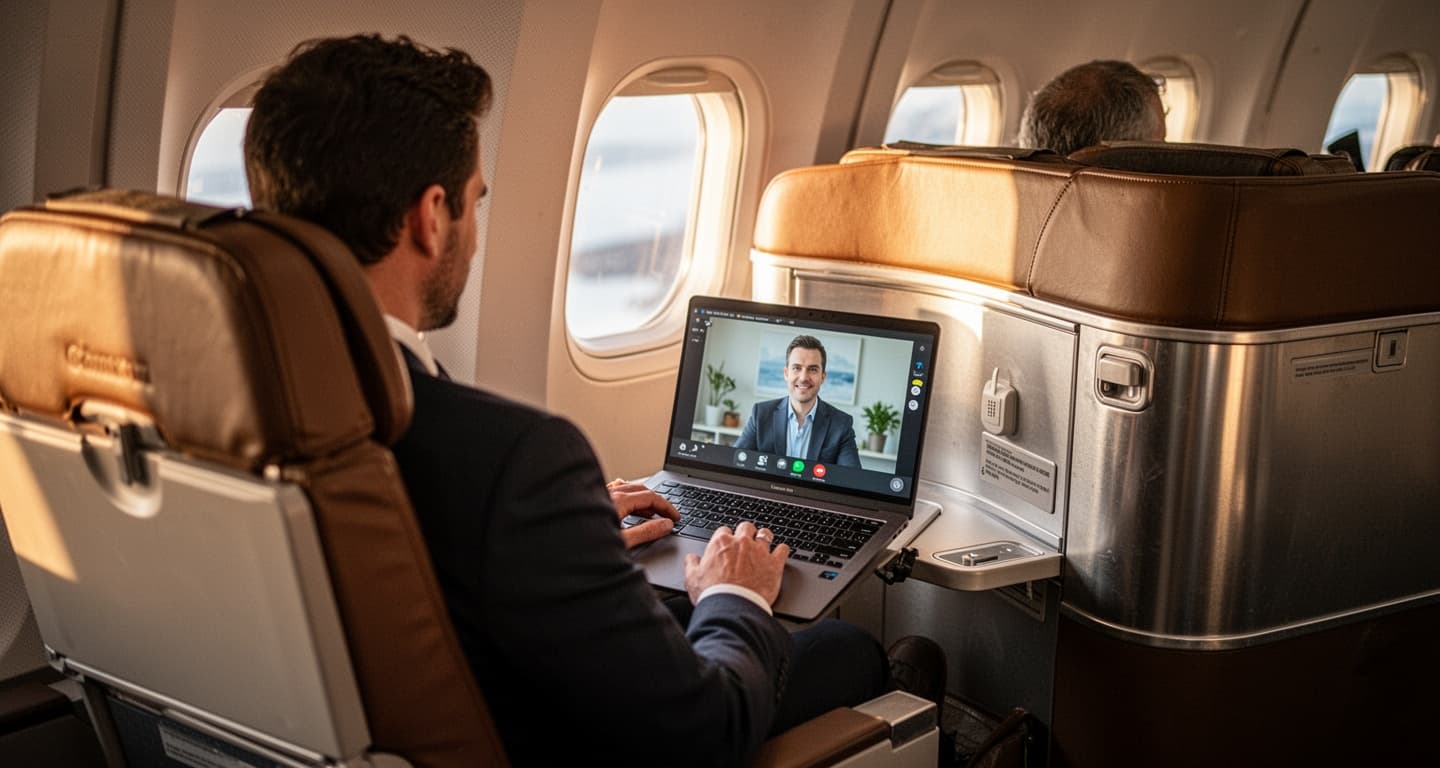
The core of the dispute is a widening rollout gap. United Airlines has already outfitted 450 aircraft with Starlink, roughly half its mainline fleet, and expects to hit nearly 1,000 by the end of 2026. Delta, by contrast, won’t begin installing Amazon Leo hardware on its first 500 aircraft until 2028—a timeline that leaves it three years behind its chief rival. For premium travelers who depend on reliable high-speed connectivity for work or streaming, that gap is no longer theoretical.
The scope extends well beyond a single social media spat. United’s Starlink advantage now covers a substantial portion of its domestic and international network, while Delta’s future promise remains just that—a future promise. With American Airlines, Southwest, Alaska Airlines, and Frontier all signing Starlink deals, the satellite internet provider has become the dominant in-flight broadband choice among U.S. carriers. Delta’s decision to bet on Amazon’s still-scaling constellation has placed it in a lonely position, and Musk’s public pressure is ensuring the market notices.
The connectivity gap in numbers
United’s Starlink rollout has been aggressive. The carrier confirmed in its Q2 2026 investor update that 450 aircraft were already flying with the service, with a target of close to 1,000 by December 2026 and full fleet coverage by 2027. CEO Scott Kirby has repeatedly told investors that faster Wi-Fi is a competitive advantage, not just a passenger perk, and that he expects meaningful market-share gains.
Delta’s path is slower. The airline announced on March 31, 2026, that it had selected Amazon Leo to power free in-flight Wi-Fi, with installation on an initial 500 aircraft beginning in 2028. The service will be free for SkyMiles members. Amazon had roughly 200 satellites in orbit at the time of the deal and must scale that constellation significantly before the 2028 window opens. Delta CEO Ed Bastian has defended the choice on technology and cost grounds, pointing to lower latency and integration with the carrier’s broader digital ecosystem.
The competitive landscape is now lopsided. United’s Starlink-equipped aircraft are already flying and expanding rapidly, while Delta’s Amazon Leo remains a future feature. For travelers who need to work, stream, or stay connected on long-haul and transcontinental routes, that difference is tangible today.
| Airline | Wi-Fi Provider | Current Status | Rollout Target | Cost to Passengers |
|---|---|---|---|---|
| United Airlines | Starlink | 450 aircraft equipped | ~1,000 by end 2026; fleet-wide by 2027 | Free |
| Delta Air Lines | Amazon Leo | Not yet available | 500 aircraft starting 2028 | Free for SkyMiles members |
| American Airlines | Starlink | Deal signed; not yet deployed | 500+ narrowbody jets starting 2027 | Free (expected) |

Flight deals most people never see
Our AI monitors 150+ airlines for pricing anomalies that traditional search engines miss. Air Traveler Club members save $650 per trip per person on average: see how it works.
Each deal saves 40–80% vs. regular fares:

Why the Wi-Fi war matters now
The public spat between Musk and Delta has done something unusual: it has turned a back-of-mind amenity into a visible product differentiator. While network scale, schedules, and elite-status programs still drive the bulk of airline loyalty, free Wi-Fi has become a baseline expectation. When two carriers offer comparable schedules and hard products, connectivity quality can tip the decision—and United currently holds that edge.
Air Traveler Club’s analysis of United’s Starlink strategy explored how the carrier is using connectivity as a competitive wedge, a dynamic now playing out in public. For premium travelers, the practical consequence is clear: if high-speed internet matters on a given trip, United’s expanding Starlink fleet makes it the safer choice through at least 2027. Delta’s Amazon Leo promise, while potentially strong, remains nearly two years away from its first cabin appearance—and that’s only if Amazon’s satellite ramp stays on track.
How to factor Wi-Fi into your next booking decision
For travelers who rely on high-speed connectivity during flights, United’s expanding Starlink fleet offers a near-term advantage that can influence carrier choice. While Wi-Fi alone rarely overrides schedule or elite-status considerations, it increasingly functions as a tiebreaker when other factors are equal.
- Check aircraft type before booking. United’s Starlink is not yet on every plane. Use the seat map or flight status details to confirm whether your specific flight is equipped.
- Prioritize United on long-haul and transcontinental routes. These are the segments where reliable, high-speed Wi-Fi has the greatest impact on productivity and entertainment.
- Don’t book Delta today expecting Starlink-like performance. Amazon Leo remains a future promise. If connectivity is critical, Delta won’t match United’s current experience until at least 2028.
- Monitor United’s fleet updates. The carrier expects to reach nearly 1,000 Starlink aircraft by end of 2026, meaning the equipped footprint will grow rapidly in the coming months.
- Let Wi-Fi be the tiebreaker when elite status and schedules are equal. On overlapping routes where both carriers offer similar hard products, Starlink availability can tip the decision toward United.
FAQ
Is United’s Starlink Wi-Fi really free?
Yes. United offers Starlink connectivity at no charge on equipped aircraft, with gate-to-gate coverage. There is no requirement to hold elite status or a specific fare class.
When will Delta’s Amazon Leo Wi-Fi be available?
Delta plans to begin installing Amazon Leo on an initial 500 aircraft starting in 2028. The service will be free for SkyMiles members, but no earlier availability is expected.
Can I get Starlink on American Airlines?
American Airlines has signed a deal to install Starlink on more than 500 narrowbody jets beginning in 2027. It is not yet available on American flights.
Does in-flight Wi-Fi really influence airline choice?
A 2018 Inmarsat survey found that Wi-Fi quality does affect passenger airline choice, and the current connectivity gap between United and Delta makes it a more visible factor than in the past. However, schedules, network reach, and elite-status benefits still drive most booking decisions.
Read more