Summary
Airbus has moved its A350-1000 First Class Experience from concept study into formal development, with Airbus vice president of cabin marketing Ingo Wuggetzer confirming at this year’s Aircraft Interiors Expo in Hamburg that the manufacturer has “stopped the studies” and is now “in the development phase.” The concept reconfigures the entire front of the A350-1000 into a 1-1-1 layout, relocates lavatories and crew rest access into a new Centre Module, and introduces a center-section Master Suite designed for two passengers — with at least five airlines already evaluating elements for their forthcoming A350 cabins.
First service entry is targeted from around 2030, meaning this product remains years from any booking window. Airlines in the customization phase are shaping the final design now, and a named launch-customer announcement would be the clearest signal that the concept is moving toward commercial reality.
The future of first class just got a formal engineering mandate. Airbus has confirmed it is now in active development on its First Class Experience for the A350-1000 — a concept that doesn’t merely upgrade a seat but restructures the entire nose of the aircraft to create a new category of airborne privacy.
Speaking at Aircraft Interiors Expo 2026 in Hamburg, Airbus vice president of cabin marketing Ingo Wuggetzer described the shift in unambiguous terms: the manufacturer has moved past feasibility studies and is now engineering a product that airlines can actually order. At least five carriers are already in the customization phase, with the first aircraft expected to enter service from around 2030.
The timing is deliberate. As the Airbus A380 gradually recedes from active fleets, the A350-1000 is inheriting the flagship role at carriers that built their brand identity around ultra-premium long-haul travel. Airbus is betting that those airlines will need a product that does more than match existing first class — it needs to define a new tier above it.
Wuggetzer framed the market shift plainly: while the average number of first class seats per aircraft has dropped from eight to five since 2021, the seats themselves are becoming more exclusive. The push to separate genuine first class from what he called “business-plus” products is, in his words, “really hard” right now — and that pressure is what moved Airbus from concept to commitment.
What Airbus is actually building
The First Class Experience concept, detailed in Airbus’s official materials, reworks the A350-1000 from Doors 1 forward in ways that go well beyond seat selection. Lavatories, stowage monuments, and the access stairs to the Forward Crew Rest Compartment are consolidated into a new Centre Module positioned just behind Doors 1, directly opposite the cockpit door. That relocation frees the floor area between Doors 1 and 2 for a wider, more spatially generous first class zone.
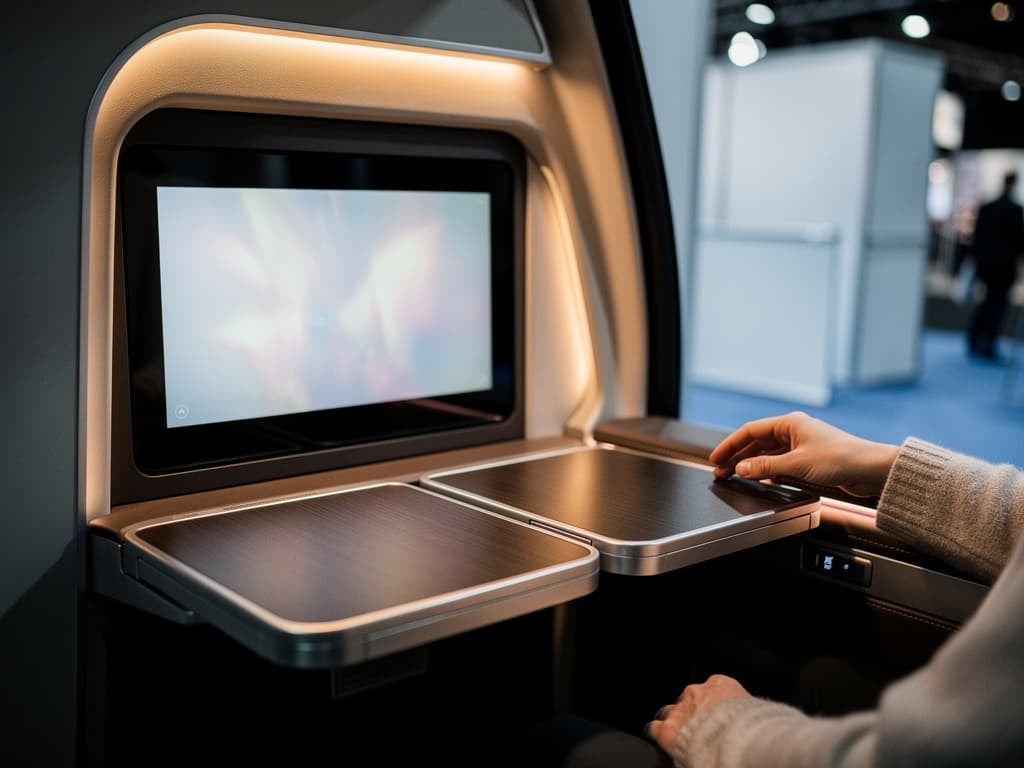
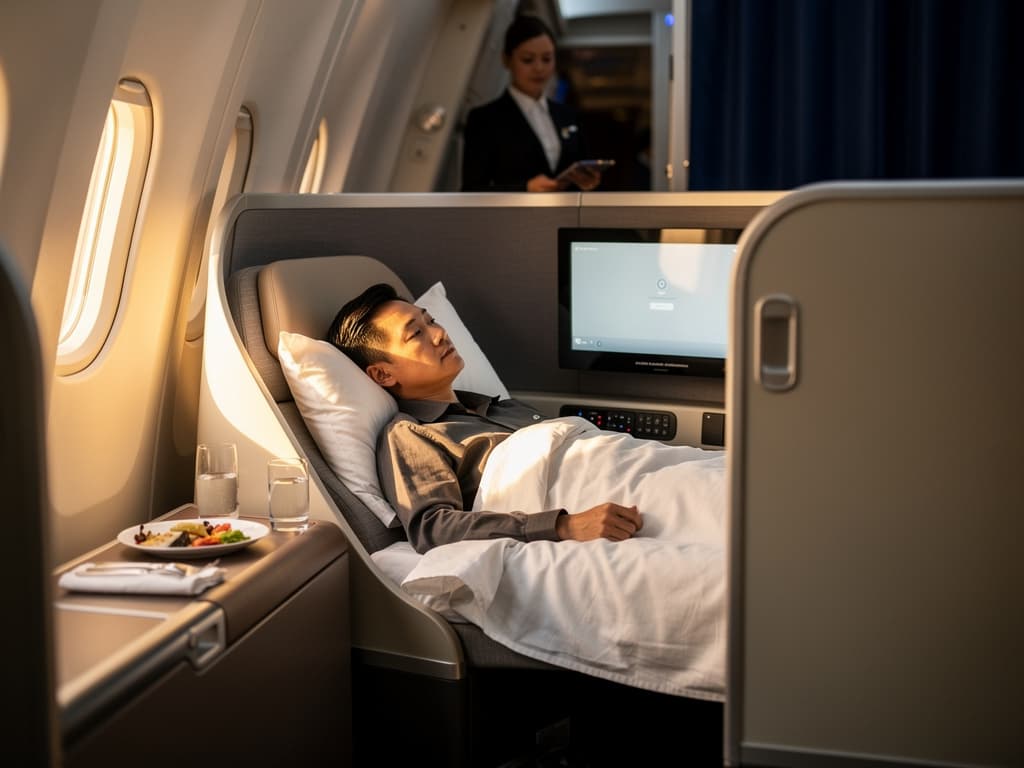
The resulting layout places a center-section Master Suite — capable of accommodating two passengers with access to a dedicated lavatory — flanked by window suites in a true 1-1-1 configuration. Each suite features 4K wraparound screens functioning as digital windows, with integrated lighting designed to replace the visual experience of a conventional porthole. Engineers also customized the A350 ceiling profile to create a larger entrance feel.
Wuggetzer acknowledged the industrial complexity directly: “numbers are low but we still have a very customized, complex product, with high-end quality.” The modular architecture is Airbus’s answer to that challenge — airlines can adopt specific elements rather than committing to the full configuration, which explains why five carriers are evaluating components rather than the complete redesign.
A total of 10 airlines have ordered A350s with first class cabins, and some are already flying. Japan Airlines, SWISS, and Lufthansa are current A350 first class operators drawing strong reviews — with Lufthansa having just won a Red Dot Award for its Allegris first class. Qantas and Singapore Airlines are targeting new A350 first class cabins by 2027, while Air India is among the five carriers now in the customization phase for future aircraft.
| Airline | Status | Aircraft | Expected service entry |
|---|---|---|---|
| Japan Airlines | In service | A350-1000 | Active |
| Lufthansa (Allegris) | In service / expanding | A350-900 | Active; Singapore route from Oct 2026 |
| SWISS | In service | A350-900 | Active |
| Qantas | Pre-service | A350-1000 | Targeted 2027 |
| Singapore Airlines | Pre-service | A350-900 | Targeted 2027 |
| Air India + 4 others | Customization phase | A350-1000 | From around 2030 |

Flight deals most people never see
Our AI monitors 150+ airlines for pricing anomalies that traditional search engines miss. Air Traveler Club members save $650 per trip per person on average: see how it works.
Each deal saves 40–80% vs. regular fares:

Why this matters beyond the renderings
Airbus is not describing an incremental seat upgrade. The Centre Module relocation, the ceiling modification, and the 1-1-1 floor plan represent structural changes to the aircraft’s forward section — the kind of engineering commitment that doesn’t get reversed once a launch customer signs. That’s the meaningful signal here: Airbus has moved from “we could do this” to “we are doing this,” and airlines are already shaping the outcome.
The competitive context sharpens the picture. Air Traveler Club’s analysis of the most private first class suites in 2026 benchmarks the current apex of commercial cabin privacy — products like Etihad‘s The Residence at 125 square feet and Singapore Airlines A380 Suites at 50 square feet. Airbus’s First Class Experience is explicitly targeting that tier, not the broader first class market.
The scarcity dynamic is already baked in. With only five airlines in the customization phase and service entry from 2030, this product will debut in extremely limited inventory — likely on specific aircraft within a carrier’s fleet rather than across an entire A350 operation. That means route-by-route variability will define access for years after launch.
What the development timeline means for A350 first class bookings
This is an awareness story with a long development runway — no booking action is possible today, but the trajectory has clear implications for how premium long-haul inventory will evolve through the end of the decade.
The critical forward signal is a named launch customer publicly committing to the Centre Module and 1-1-1 configuration. That announcement — when it comes — will confirm that Airbus has secured the engineering investment justification and that a specific carrier’s A350-1000 fleet plan is locked around this product. Until then, the five airlines in the customization phase are shaping a design that remains subject to change.
Watch for seat-map updates from Air India and other A350-1000 operators over the next 12–24 months. New-build aircraft entering service from 2030 onward are the likely first vehicles for any adopted elements — retrofits across mixed fleets are structurally unlikely given the ceiling and floor modifications involved. If Airbus announces a formal launch partner before the end of 2026, expect the competitive response from Boeing and rival cabin suppliers to accelerate on similar timelines.
FAQ
Which airlines are most likely to be the first to offer the Airbus First Class Experience?
Airbus has confirmed at least five airlines including Air India are in the customization phase for new A350-1000 first class cabins, and elements of the First Class Experience concept could be adopted by any of them. Carriers already operating A350-1000s with first class — and those with new-build orders — are the most plausible launch candidates. No airline has been publicly named as a committed launch customer as of May 2026.
Can I book the Airbus A350-1000 First Class Experience now?
No. The product is in the development phase and Airbus says the first aircraft incorporating these elements could enter service from around 2030. It is not currently available for booking on any carrier. The five airlines in the customization phase are still shaping their individual cabin programs, and no seat maps or schedules have been published for this specific configuration.
How does the Centre Module relocation improve the passenger experience?
By consolidating lavatories, stowage monuments, and Forward Crew Rest Compartment stairs into a single module behind Doors 1, Airbus removes the crew movement that typically passes through the first class cabin during flight. The result is a quieter, less interrupted sleep environment — particularly relevant on ultra-long-haul routes where rest quality is a primary driver of first class demand.
Is the Master Suite designed only for couples?
No. Airbus describes the center-section Master Suite as capable of accommodating two passengers, but the modular design is intended to serve solo travelers as well. The configuration gives airlines flexibility to market the suite as a shared or private space depending on their product positioning.
Read more