Summary
Emirates Airbus A380 business class on the same long-haul route can carry a one-way price tag anywhere from roughly $2,500 on a discounted saver fare to well over $6,000 on a Business Flex ticket — a spread driven almost entirely by fare bucket availability and when you book. March 2026 fare checks confirmed one-way business fares from New York-JFK to Dubai at $4,669 on the lowest available fare versus $6,442 for the flex equivalent on the same flight.
The gap isn’t random — it’s yield management working exactly as designed. Saver inventory is finite, opens unpredictably, and disappears fast on high-demand routes.
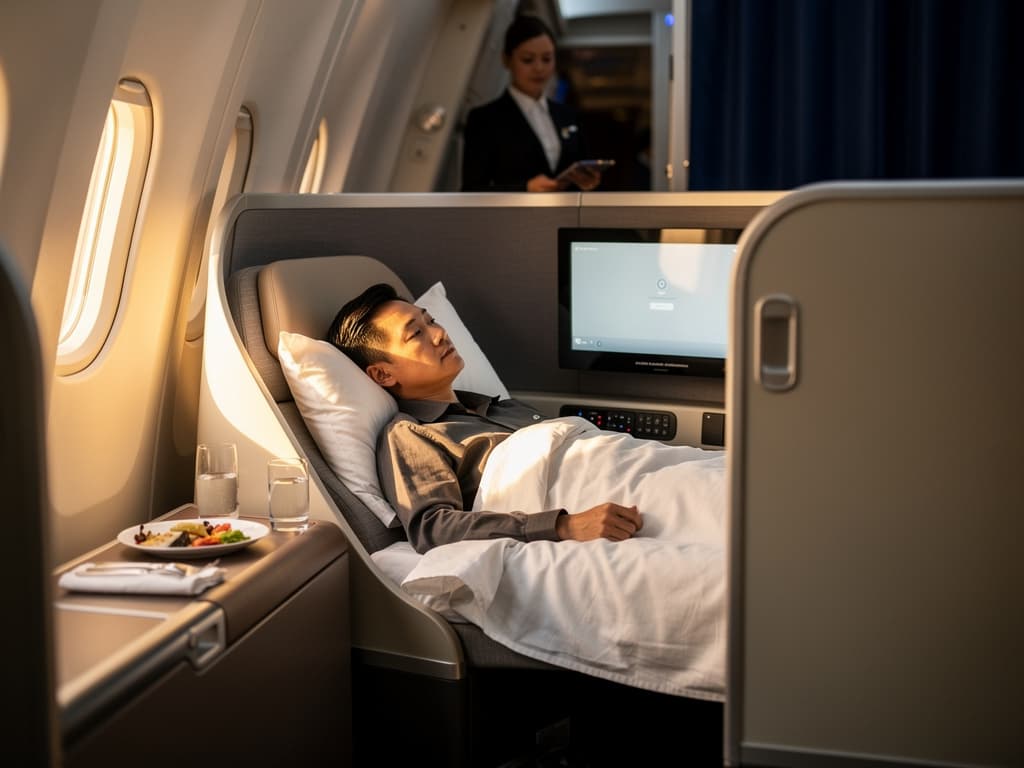
Airline pricing has always been opaque, but few products illustrate the gap between floor and ceiling quite like Emirates A380 business class. The seat, the lounge, the chauffeur-drive — none of it changes between fare classes. What changes is how much of the cabin Emirates has already sold and how aggressively it needs to fill the rest.
The numbers are striking. On the Dubai–London and Dubai–New York corridors, one-way business fares have been documented ranging from approximately $2,500 at the discounted end to well above $6,000 at the flex tier. That’s not a seasonal anomaly — it’s a structural feature of how Emirates manages premium-cabin revenue on its flagship routes.
March 2026 fare data showed the pattern clearly across U.S. departure cities: Chicago and Washington-Dulles came in at $4,417 one-way, Miami and New York-JFK at $4,669, Los Angeles at $4,832, and San Francisco at $4,877 — all on the lowest available business fare. The Business Flex fare on the JFK–Dubai pairing sat at $6,442 for the same routing.
Understanding that spread is the difference between overpaying by thousands of dollars and booking the same lie-flat bed at a materially better price.
How Emirates builds a $4,000 price gap into one cabin
Emirates operates a tiered fare structure within its business cabin — saver buckets at the low end, flex fares at the top — and the inventory allocated to each tier shifts constantly based on load factors, booking pace, and route demand. The airline’s A380 business class product page confirms the full suite of perks — chauffeur-drive in select markets, access to the onboard lounge, lie-flat beds, and premium dining — but publishes no fare rules or booking-window guidance. That silence is intentional: the airline has no incentive to tell you when cheap inventory appears.
Historical pricing reinforces that this isn’t a new phenomenon. A 2019 review of the Dubai–New York route documented an A380 business-class fare of $5,400 — squarely in the mid-range of what the market shows today. The current pricing behavior is consistent with years of Emirates yield management on marquee trunk routes, not a post-pandemic pricing spike.
| Departure city | Lowest available fare (one-way) | Business Flex fare (one-way) | Price gap |
|---|---|---|---|
| Chicago O’Hare (ORD) | $4,417 | Data pending verification | — |
| Washington Dulles (IAD) | $4,417 | Data pending verification | — |
| Miami (MIA) | $4,669 | Data pending verification | — |
| New York JFK | $4,669 | $6,442 | $1,773 |
| Los Angeles (LAX) | $4,832 | Data pending verification | — |
| San Francisco (SFO) | $4,877 | Data pending verification | — |

Flight deals most people never see
Our AI monitors 150+ airlines for pricing anomalies that traditional search engines miss. Air Traveler Club members save $650 per trip per person on average: see how it works.
Each deal saves 40–80% vs. regular fares:

What the pricing structure means for how you should shop
Emirates is running a textbook premium yield strategy: protect the A380 brand, hold headline fares high, and release limited lower-fare inventory to fill softer dates. The competitive context matters here — on Dubai–London and Dubai–New York, Emirates faces direct pressure from Qatar Airways, Etihad Airways, and various nonstop competitors depending on city pair. Emirates‘ edge is the A380 experience and onboard lounge; competitors sometimes win on lower cash fares or more predictable award pricing.
Air Traveler Club’s analysis of Gulf carrier business class pricing from European departure points found that market-of-origin matters enormously — travelers departing from lower-demand cities on the same airline can save over €1,000 on the identical lie-flat product. The same logic applies across U.S. gateways: the $460 spread between Chicago and San Francisco on the same route in March 2026 reflects demand differences, not product differences.
The forward signal is worth noting. If the gap between saver and flex fares continues widening through 2026–2027, it signals that Emirates is sharpening yield management rather than discounting broadly — which means the window for genuinely good cash fares will narrow, not widen, over time.
How to find the lower end of the Emirates pricing range
Booking Emirates A380 business class at the saver end of the fare spectrum requires timing, flexibility, and a clear-eyed view of what the airline is actually doing with its inventory. These are the variables that move the needle:
- Book early when saver inventory first opens: Saver fare buckets tend to appear when Emirates first loads a schedule — often 11–12 months out — before demand signals push the airline toward protecting higher-yield inventory. Checking fares at schedule release is more reliable than waiting for a sale.
- Target shoulder-season departures: February–March and October–November consistently show softer demand on transatlantic and Gulf routes. The March 2026 fare data — with JFK–Dubai at $4,669 — reflects a shoulder window. Peak summer and December fares run materially higher.
- Compare departure cities: The $460 spread between Chicago and San Francisco on the same route in March 2026 is real money. If your schedule allows positioning to a cheaper gateway, the savings can exceed the cost of the connecting flight.
- Run award and cash searches simultaneously: When cash fares are elevated, Emirates Skywards award space sometimes offers better value — but award inventory on flagship routes is tight and tends to open earlier rather than closer to departure. Check both before committing.
- Watch for A380 configuration changes: Emirates is actively reconfiguring its A380 fleet — the high-density 615-seat A380 deployed on select routes carries only 58 business seats versus the standard 76, which tightens inventory further and can push fares higher on affected routes.
Watch for whether the saver-to-flex price gap continues expanding through late 2026 — a sustained widening would confirm that Emirates is leaning harder on yield management and that the window for sub-$5,000 one-way business fares is narrowing.
FAQ
What is the cheapest Emirates A380 business class fare currently available?
As of March 2026, the lowest documented one-way business fares from U.S. cities to Dubai ranged from $4,417 (Chicago, Washington-Dulles) to $4,877 (San Francisco) on saver-level inventory. Fares below $4,000 have been reported on discounted promotions but are not consistently available on flagship routes.
What is the difference between Emirates Business Saver and Business Flex fares?
Both fare types access the same A380 business class product — lie-flat bed, onboard lounge, chauffeur-drive where eligible. The difference is flexibility: Flex fares allow changes and cancellations with minimal or no fees, while Saver fares carry stricter change penalties. The price gap on JFK–Dubai was documented at $1,773 one-way in March 2026.
Does the Emirates A380 business class product vary between aircraft configurations?
The seat hardware and soft product are consistent across standard three-class A380s. However, Emirates operates a high-density two-class A380 configuration with 58 business seats in a 2-4-2 layout — compared to 76 seats in the standard 1-2-1 configuration — which reduces inventory and eliminates First Class on affected routes. Checking the seatmap before booking confirms which configuration is scheduled.
Read more