Summary
Airport lounges have reached a structural breaking point, and all three major U.S. carriers are now responding with grab-and-go concepts that decouple the food-and-drink perk from the sit-down lounge experience. American Airlines opened Provisions by Admirals Club at Charlotte Douglas International Airport in 2025 — a separately branded mini-lounge offering grab-and-go food and beverages with a one-day pass priced at $79 or 7,900 AAdvantage miles. United Airlines launched its second United Club Fly location at Houston’s George Bush Intercontinental Airport the same year, while Delta Air Lines piloted quick-serve Grab and Go areas inside existing Sky Club lobbies in Atlanta and New York.
Access rules for all three concepts mirror their parent lounges — same eligibility, same elite tiers, same credit card qualifications. Expansion to additional airports is the next signal to watch.
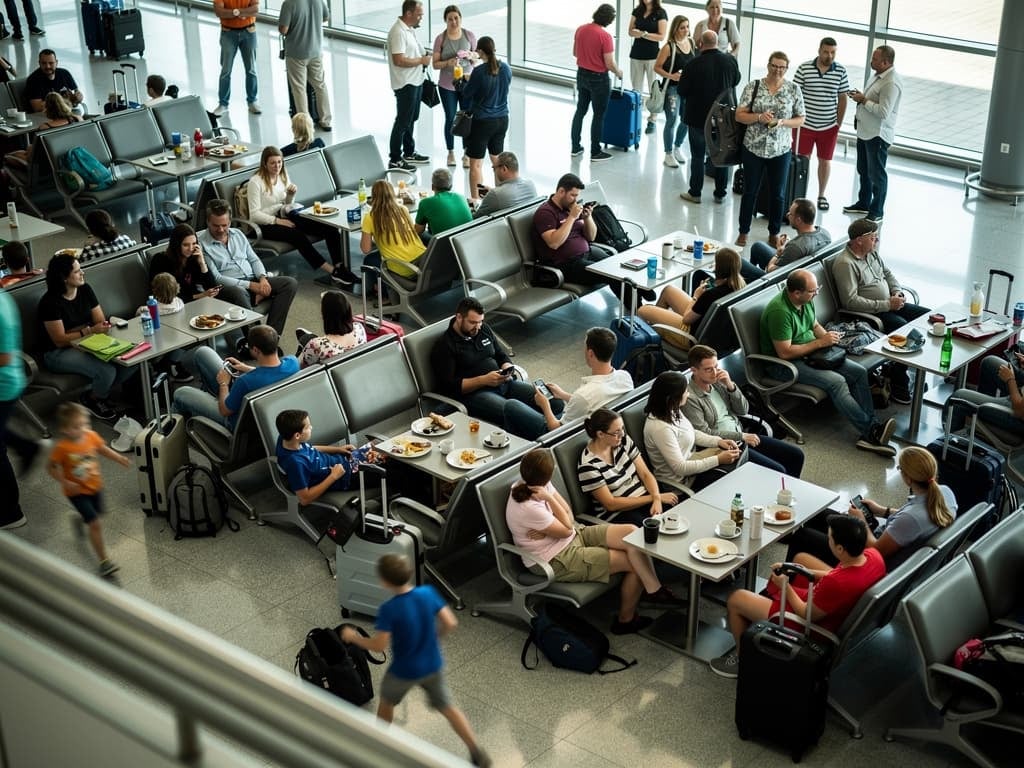
The airport lounge, once a sanctuary from terminal chaos, has become part of the chaos. Years of credit card proliferation, day-pass democratization, and elite status inflation have turned premium lounge spaces into standing-room-only waiting areas — and airlines have finally moved from acknowledging the problem to engineering around it.
The grab-and-go concept is the industry’s structural answer. Rather than expanding square footage or restricting access further, carriers are creating a parallel tier: spaces designed for speed, not comfort, that absorb the high-volume traffic that has been degrading the traditional lounge experience.
Three of the four largest U.S. carriers now have active grab-and-go programs. American Airlines opened Provisions by Admirals Club at Charlotte Douglas International Airport (CLT) in 2025, describing it as “a first-of-its-kind” concept built for “speed, simplicity and convenience.” United Airlines expanded its United Club Fly footprint to George Bush Intercontinental Airport (IAH) — also in 2025 — offering fresh-squeezed orange juice, warmed pastries, wraps, barista-made coffee, and a self-service beverage counter. Delta Air Lines took a different architectural approach, embedding quick-serve Grab and Go areas inside existing Sky Club lobbies in Atlanta and New York rather than creating separately branded spaces.
The distinction matters. United and American have built standalone mini-lounges with no seating component. Delta’s version retains the lobby environment — meaning travelers may still encounter crowding if the main club is at capacity.
The details: three programs, three different approaches
The competitive landscape reveals meaningful differences in how each carrier has structured its grab-and-go offering. American’s Provisions by Admirals Club at CLT is the most clearly differentiated — a purpose-built space with a streamlined layout, no hot kitchen, and a focus on prepackaged and ready-to-go items. Access follows traditional Admirals Club policies exactly, including guest privileges for AAdvantage Platinum Pro and Executive Platinum members. For travelers without elite status or an eligible card, a one-day pass costs $79 or 7,900 AAdvantage miles — identical to the standard Admirals Club day pass rate.
United’s United Club Fly at IAH operates under standard United Club access rules: same-day boarding pass required, with entry via eligible credit cards (including Amex Platinum and United Explorer) or Premier Gold status and above. The Houston location is the carrier’s second Club Fly, suggesting a deliberate rollout rather than a one-off experiment.
Delta’s integration into existing Sky Club lobbies is the most operationally conservative approach — and the most constrained. Existing Sky Club access policies apply in full, and the Grab and Go feature doesn’t create a separate entry point for travelers who would otherwise be denied access. This matters particularly given Delta’s February 2025 decision to cap annual lounge visits for American Express cardholders at 15 visits per year, with unlimited access requiring $75,000+ in annual card spending. That earlier restriction set the precedent for the current overcrowding response.
Industry reporting confirms all three programs are active and operational, with expansion decisions pending for 2026.
| Airline | Program name | Location(s) | Format | Day pass cost |
|---|---|---|---|---|
| American Airlines | Provisions by Admirals Club | Charlotte (CLT) | Standalone mini-lounge, no seating | $79 or 7,900 AAdvantage miles |
| United Airlines | United Club Fly | Houston (IAH) | Standalone mini-lounge, no seating | Standard United Club day pass rates |
| Delta Air Lines | Sky Club Grab and Go | Atlanta (ATL), New York (JFK) | Integrated into existing Sky Club lobby | No separate pass; existing Sky Club access required |

Flight deals most people never see
Our AI monitors 150+ airlines for pricing anomalies that traditional search engines miss. Air Traveler Club members save $650 per trip per person on average: see how it works.
Each deal saves 40–80% vs. regular fares:

The value-add: cost-cutting dressed as customer service
The strategic logic here is worth unpacking, because it runs in two directions simultaneously. On the surface, grab-and-go lounges solve a real traveler problem: the traditional lounge is useless on a 25-minute connection, and hunting for a seat in an overcrowded club wastes the only time you don’t have. A grab-and-go format genuinely serves that use case.
But the operational math also works cleanly for airlines. No hot kitchens means lower food service costs. Smaller footprints mean lower real estate overhead at airports where gate-adjacent square footage is among the most expensive in commercial real estate. Reduced staffing requirements follow from both. Airlines are simultaneously solving a customer experience problem and reducing the cost-per-lounge-visit — and framing the latter entirely as the former.
The longer-term implication is a deliberate stratification of the lounge tier. Air Traveler Club’s analysis of the gap between terminal reality and lounge promise at major hubs illustrates exactly why this stratification matters: when the baseline experience degrades, the premium tier loses its reference point. Grab-and-go concepts give airlines a mechanism to absorb volume at the mid-tier while preserving the flagship lounge — Polaris lounges, Delta One clubs, Admirals Club flagships — as genuinely differentiated spaces.
Whether that stratification holds depends entirely on whether airlines resist the temptation to extend grab-and-go access to the same credit card population that overcrowded the traditional lounges in the first place.
How to use grab-and-go lounges effectively — and what to watch next
These programs are most useful in a specific scenario: tight connections at hub airports where you have lounge access but not enough time to use it. Understanding the mechanics now positions you to use them correctly when the clock is running.
- Charlotte (CLT) connections: American’s Provisions by Admirals Club is the most accessible grab-and-go option for travelers without elite status — the $79 day pass or 7,900 AAdvantage miles purchase path works for any eligible traveler with a same-day boarding pass. Verify the location relative to your connecting gate before banking on it.
- Houston (IAH) connections: United Club Fly requires existing United Club access — there’s no standalone day pass equivalent to American’s offering. Confirm your Premier Gold status or eligible card before routing through IAH expecting grab-and-go access.
- Atlanta and New York Sky Club Grab and Go: Delta’s version is the most restricted — no separate entry, no day pass, no workaround for travelers who don’t already qualify for Sky Club access. The 15-visit annual cap for Amex cardholders applies here as it does everywhere else in the Sky Club system.
- Guest policy confirmation: All three programs inherit parent lounge guest rules, but confirm at the door — grab-and-go spaces have smaller footprints, and capacity management may be applied differently than in full-size clubs.
Watch for American Airlines announcing Provisions by Admirals Club at additional airports in Q3–Q4 2026. If the CLT pilot expands to three or more locations, it confirms grab-and-go as a permanent structural tier in American’s lounge strategy — not a single-airport experiment.
FAQ
Do grab-and-go lounges count against Delta’s 15-visit annual cap for Amex cardholders?
Delta’s current Sky Club rules confirm that existing access policies and eligibility rules apply to all Grab and Go entries. That means yes — each Grab and Go visit counts against the annual visit cap for American Express cardholders subject to the 15-visit limit introduced in February 2025.
Can I bring a guest to American’s Provisions by Admirals Club?
Guest policies at Provisions by Admirals Club follow standard Admirals Club rules. AAdvantage Platinum Pro and Executive Platinum members may bring up to two guests. Travelers entering on a day pass or eligible credit card are subject to the same guest fee structure as traditional Admirals Club locations.
Is there a Priority Pass option for any of these grab-and-go lounges?
As of June 2026, none of the three grab-and-go programs — United Club Fly, Provisions by Admirals Club, or Delta Sky Club Grab and Go — accept Priority Pass or DragonPass as standalone entry credentials. Access remains tied to airline-specific eligibility: elite status, co-branded credit cards, or direct day passes where available.
Are there plans to expand these concepts to international airports?
No confirmed international expansion has been announced by any of the three carriers as of June 2026. Current locations are limited to U.S. domestic hubs — Charlotte, Houston, Atlanta, and New York. International lounge operations involve different regulatory and concessionaire structures that complicate a direct rollout of the domestic grab-and-go model.
Read more