Summary
A firsthand account of Turkmenistan Airlines’ business class between Frankfurt and Ashgabat reveals a surprisingly normal premium experience aboard an ex-Cathay Pacific Boeing 777-300ER — shattering the carrier’s mysterious, restrictive image. The one-way fare to Delhi priced at $1,000 in July 2026, with only three passengers occupying 40 reverse herringbone seats, while multi-course meals and unusually attentive service delivered comfort far above expectations.
The heavily padded 6-hour schedule masks a 4-hour-35-minute flight, ensuring near-perfect on-time stats, but Ashgabat Airport’s ghost-town security and opaque transit rules add complexity. For premium travelers seeking a bargain Europe-India routing, the window may narrow as a second 777-300ER enters service.
Turkmenistan Airlines has long existed in the imagination of aviation enthusiasts as a black box of restrictive state control. A new review, published July 17, flips that narrative on its head — the business class experience turned out to be “rather pleasant” and “only mildly strange,” despite an itinerary that transits one of the world’s most secretive capitals.
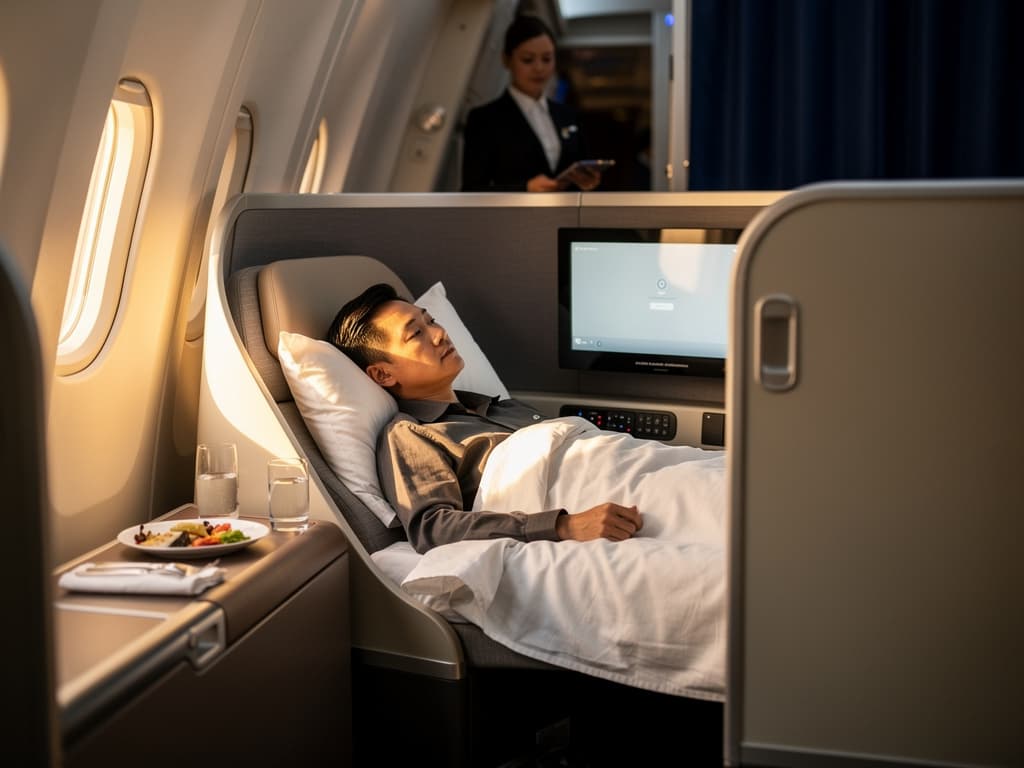
The $1,000 one-way fare from Frankfurt to Delhi, operated via Ashgabat, undercuts nonstop Lufthansa and Emirates business-class tickets by $2,500 to $4,000 on the same corridor. While the savings are staggering, the journey demands patience. The Frankfurt–Ashgabat leg is scheduled at six hours but completed in 4 hours 35 minutes, a padding tactic that guarantees on-time arrivals while aircraft stand idle. The airline’s ex-Cathay Pacific 777-300ER — one of two acquired under the “National Program for Civil Aviation 2012–2030” — retains the original 1-2-1 reverse herringbone cabin, giving every seat direct aisle access and a bed that, while dated, remains functional. On the review flight, just three passengers spread across 40 seats at peak summer demand.
Service on board defied every preconception. Flight attendants served a short rib dinner with elaborate drink presentation, then a pre-landing sandwich — the kind of multi-course rhythm more familiar on top-tier Gulf carriers. The inflight entertainment offered “The Big Bang Theory” alongside a curious outlier: a Dr. Fauci interview on public health politicization. And when one passenger fumbled with a blanket, a crew member simply tucked them in, a moment that will resonate with anyone who values genuine attentiveness over scripted luxury.
The product, the politics, and the lavatory surprise
The heart of the experience is the seat itself. Those familiar with Cathay Pacific’s earlier 777 business class will recognize the layout immediately — 40 seats with moderate privacy, no sliding doors, and a cabin that feels spacious only because it’s nearly empty. The forward lavatory, however, still wears Cathay first-class fixtures, including a communal tin of Nivea cream, an artifact that is equal parts nostalgia and hygiene question mark.
The inflight magazine dedicates nearly every page to the country’s president, and the IFE library is sparse, but the seat’s fundamentals hold up. A proper lie-flat bed, ample storage, and USB power outlets make the four-and-a-half-hour sector restful. Turkmenistan Airlines’ fleet data shows the aircraft, registered EZ-A782, is approximately 12 years old and was delivered after a government-led expansion push that prioritized cargo over passengers. Business-class loads remain so light that empty cabins are the norm rather than the exception, a fact reflected in the fare.
| Airline | Route | Aircraft / Seat Product | Key Specs | Approximate One-Way Fare (Business) |
|---|---|---|---|---|
| Turkmenistan Airlines | Frankfurt–Ashgabat–Delhi | 777-300ER / Reverse Herringbone 1-2-1 | Lie-flat, direct aisle, 15.4″ IFE, light loads | $1,000 |
| Lufthansa | Frankfurt–Delhi (nonstop) | A350 / A380 Business | Lie-flat, superior IFE, Allegris retrofit on some | $3,500–$5,000 |
| Emirates | Frankfurt–Dubai–Delhi | 777 / A380 Business | Lie-flat, A380 bar, newer suites | $2,800 |
| Air India | Frankfurt–Delhi (nonstop) | 787 / 777 Business | Lie-flat, improving service, older seats | $2,200 |

Flight deals most people never see
Our AI monitors 150+ airlines for pricing anomalies that traditional search engines miss. Air Traveler Club members save $650 per trip per person on average: see how it works.
Each deal saves 40–80% vs. regular fares:

The real calculus: what $1,000 really buys
For the price, Turkmenistan Airlines offers a functional, comfortable hard product and service that, by most accounts, punches above its weight. But the value proposition dissolves on the ground. Ashgabat Airport operates with a ghostly skeleton crew and a security-to-passenger ratio that feels punitive. Transit visa requirements vary by nationality and can stall even the most resourceful traveler. The 6-hour blocked time means that while flights almost never arrive late, passengers trade schedule flexibility for padded blocks that may include hours of sterile transit time.
Air Traveler Club’s analysis of ZIPAIR’s $1,000 lie-flat seat demonstrates that ultra-low-cost business models often strip away frills; Turkmenistan Airlines, by contrast, keeps the meal service and cabin crew charm but demands geopolitical risk tolerance. That trade-off will appeal to a narrow slice of premium travelers — avgeeks, extreme value hunters, and those routing between Europe and India on a tight cash budget — but it is not a mass-market contender.
With a second ex-Cathay 777-300ER already confirmed and expected on the same trunk route, the current $1,000 fare point could erode. Airlines typically raise yields as frequency rises, and if loads remain light, a launch-promo normalization toward $1,500–$2,000 is plausible within 6–12 months.
How to act on the opportunity before it shifts
The $1,000 fare demands a calculated approach — low risk for the seat, higher risk for the logistics. Anyone considering this routing should move with speed and rigour.
- Verify transit visa requirements first. Ashgabat’s rules are nationality-dependent and poorly documented online. Use the airline’s European portal or a specialist visa service before any booking, as denied transit could strand you far from help.
- Book directly and early. Light loads mask limited seat release at the $1,000 level. Search 8–12 weeks out on the airline’s official European site and compare against aggregators; fare bucket availability can vanish overnight.
- Account for padded schedules. The 6-hour block on a 4.5-hour flight creates long on-ground time in Ashgabat. If connecting onward to Delhi, plan for a minimum 3-hour transit — and accept that the terminal offers almost no services.
- Monitor the second 777-300ER. Fleet tracker KNAVIGATION confirms airframe EZ-A783 is likely destined for the Frankfurt–Ashgabat–Delhi rotation. If announced, frequency could rise, but so might pricing. Lock in before any formal launch to hedge against higher fares.
- Use alternatives when schedule matters. Lufthansa’s nonstop remains the time-saver; Emirates’ Dubai connection offers a polished experience with A380 lounge perks. Reserve the Ashgabat routing only when price trumps convenience.
FAQ
Does Turkmenistan Airlines have a frequent flyer program?
No. The airline operates no loyalty scheme, and elite status benefits from any alliance are not recognized. The value lies entirely in the cash fare and onboard product.
How safe is Turkmenistan Airlines operationally?
The carrier has no recent major accident record and is not subject to EU or US operational bans. Its fleet maintenance follows the ex-Cathay Pacific cycles, and schedule padding reduces pressure on time-critical turnarounds. Assess transit country risk separately from flight safety.
What are Ashgabat Airport’s transit facilities like?
Ashgabat Airport is modern but minimally staffed. Reports describe heavy security presence, few dining or lounge options, and almost no Wi-Fi. Transit passengers remain in a sterile area; expect a subdued, quiet environment with long waits if connections are misaligned.
Read more